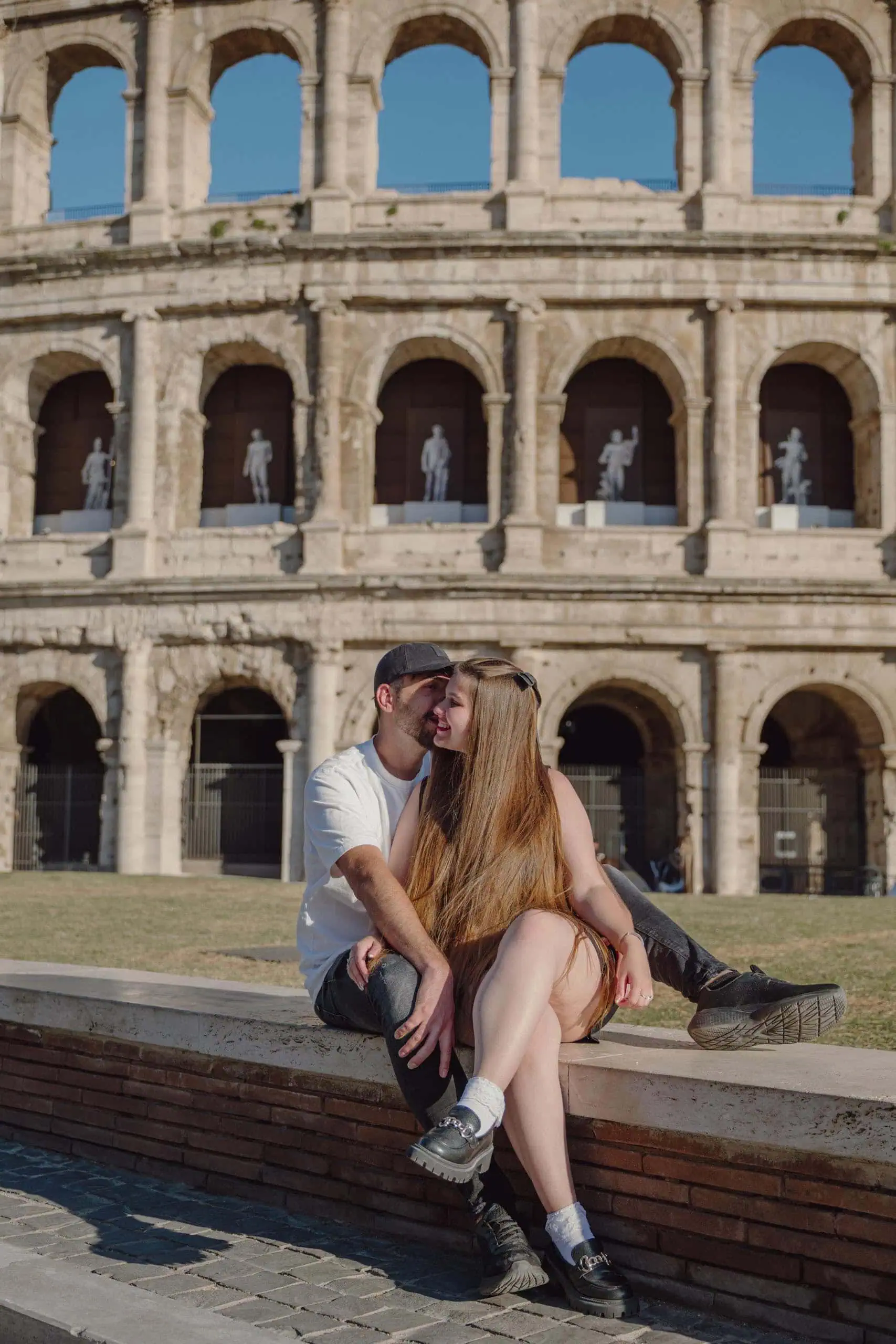
Colour, layering, and footwear choices that work in Rome's cool seasons
For a photoshoot in Rome in autumn or winter, wear rich earthy tones, structured layers, and boots that handle cobblestones. That single sentence covers the core of it. This guide breaks down colour palettes, fabric choices, footwear, what to avoid, and how the season's light should shape every outfit decision. It applies to couples, families, solo travellers, and anyone planning a session between October and February.
Rome's cool seasons are genuinely good for photography. Crowds are thinner, the stone of the city is damp enough to carry depth and texture, and the lower sun angle stretches golden hour. The challenge is dressing in a way that looks deliberate on camera, stays warm enough for a session that covers three to five kilometres on foot, and does not fight the colour of Rome's walls and ruins. Get that balance right and the season does half the work for you.
Autumn in Rome runs from late September through November. According to climatestotravel.com, precipitation amounts to around 750 mm per year, with autumn being the wettest season. October averages around 19°C, falling to 7-15°C by November. December through February sits between 3°C and 12°C on most days, with rain every few days and occasional cold snaps after dark. These are not extreme conditions, but they matter for clothing choices.
The payoff for cooler temperatures is better light. As timeofsunrise.com notes, "autumn light has a distinctive warm quality" and "the lower sun angle produces extended golden hour periods compared to summer." In December, Rome has around 9.2 hours of daylight, which means golden hour arrives earlier and sessions timed around it are easier to plan. That amber, low-angle light is the reason earth-toned outfits work so well in this season: the light and the palette are already on the same page.
TipBook a golden-hour session in winter and you get warm light on your faces at a much more sociable hour than in summer.
| Package | Price | Duration | Photos | Locations |
|---|---|---|---|---|
| Essential | €300 | 1 hour | 30 photos | 1 location |
| Signature | €500 | 2 hours | 50 photos | 2 locations |
| Prestige | €800 | 3 hours | 60 photos | 3 locations |
Earthy tones are the strongest choice: camel, burgundy, olive, rust, sage, deep teal, and cream. Rome's travertine, terracotta, and ochre walls already supply a warm neutral backdrop. Colours in the same register sit inside that backdrop rather than competing with it. A burgundy coat against pale stone reads beautifully. Dusty blue works against the brick of Trastevere. Olive and forest green anchor well in Villa Borghese's autumn foliage.
Avoid pure bright white and neon shades. Pure white blows out in direct autumn light and picks up colour cast from orange walls. Neon pulls the eye away from faces and the location. Heavy logo prints do the same. Solid colours, subtle patterns, and fine texture photograph cleanly. If your group wants variety, agree on a shared palette: two or three tones that sit in the same family rather than matching exactly. That keeps portraits cohesive without looking like a uniform.
TipItalians build an outfit on neutrals with one accent. Apply the same logic to your photoshoot look.
Layering is the practical answer to Rome's autumn and winter temperatures, which can drop sharply after sunset. The formula that works on camera is: a fitted base layer, a mid-layer in a rich fabric such as merino wool or fine knit, and a structured outer layer. A wool or cashmere coat photographs better than a puffer because it holds a clean silhouette. If a puffer is what you own and it is cold enough to need it, choose a longer, single-colour version rather than a short, quilted style.
"I tell clients to bring their coat for the walking sections and remove it for the close-up frames," Finzi says. "A great coat is worth keeping in the shot. A shapeless one is not. The mid-layer underneath should be strong enough to stand alone for a few frames." Scarves double as a styling accessory and a warmth tool. A single scarf in a warm tone adds colour without adding bulk. Gloves should stay in a pocket during frames unless the session is in deep winter and removing them is not practical.
TipPack the coat separately if you are using public transport to the location so it arrives uncrumpled.
Footwear is where comfort and camera-readiness most frequently conflict. A session covers three to five kilometres across uneven cobblestones, steps, and occasionally wet stone. Heels above a low block heel are genuinely risky on Rome's streets and will show in your posture if they are uncomfortable. Ankle boots with a low heel, knee-high leather boots, or quality Chelsea boots are the strongest choices: they photograph cleanly, handle the terrain, and work with the layered autumn-winter looks described above.
If November or December rain is forecast, waterproof or water-resistant leather is worth prioritising. Cobblestones collect water in the joints and a soaked shoe makes a session miserable. Clean sneakers in a neutral tone are a practical fallback and increasingly common in Rome's street style. Whatever you choose, wear them in before the session. New stiff boots on cobblestones for two hours is one of the most common and avoidable sources of discomfort during a shoot.
TipWear boots during the session and pack flat shoes in a bag if your feet need a break between locations.
In autumn and winter, the sun sits lower in the sky at all times of day. That means the warm-toned side light you only get at golden hour in summer is available for a longer window across the whole day. It also means that midday light, which is harsh and overhead in summer, becomes softer and more flattering in December and January. Sessions starting mid-morning still deliver usable, directional light rather than flat overhead wash.
The practical implication for clothing is that texture matters more in this season. A fine merino knit, a brushed wool coat, a velvet midi skirt, or a suede jacket will all catch the low-angle light and show dimension. Flat, shiny, or synthetic fabrics reflect light differently and can look cheaper on camera in this kind of light. Natural fibres in matte or semi-matte finishes are the consistent recommendation for cool-season sessions in a stone city.
TipDarker, richer fabrics absorb autumn light in a way that adds warmth rather than reflecting it back flat.
Different Rome locations have different dominant tones, and autumn-winter outfits give you the range to match them. The Roman Forum and Colosseum are sand, amber, and raw stone: camel, terracotta, and deep burgundy all slot in. Trastevere's orange-washed walls suit rust, olive, and dark denim. Piazza Navona is cooler and more formal, which makes deep navy, charcoal, and cream work well. Villa Borghese in October and November has copper and gold foliage, making it one of the best locations in the city for autumn session outfits in warm tones.
For a Signature or Prestige session across two or three locations, think about whether one outfit palette travels across all of them or whether you want a change between stops. A camel coat reads well anywhere. A very location-specific colour might feel mismatched at the second stop. The practical approach: anchor in a neutral, use your accessories to introduce the accent colour at each location.
TipShare your planned location with Finzi before the session and confirm that your palette will work there.
Logos and branded graphics pull the eye away from faces. Mismatched outfit tones across a group make portraits look accidental rather than composed. Overly formal suits or ball gowns read as costume on Rome's streets in autumn and create a disconnect with the environment. Coordinated matching outfits where every person wears exactly the same colour look flat and staged. The goal is cohesion, not uniformity.
Very busy prints, wide horizontal stripes, and clashing patterns all compress awkwardly in a compressed image frame. One person in a bold pattern is workable if the rest of the group is in solids. Everyone in a bold pattern is distracting. The same applies to layering too many strong colours at once: three earth tones together work; four competing accent colours do not. Simplicity in layering and restraint in pattern almost always produces a stronger image.
TipWhen in doubt, reduce by one. Remove the busiest element from your planned outfit before the session.
I shoot at over 30 locations across Rome, including the Colosseum, Trevi Fountain, Trastevere, Villa Borghese, Piazza Navona, the Spanish Steps, and more. Autumn and winter are good times to book: crowds are lower than peak season, and the light is genuinely strong during the cooler months. I recommend booking at least two to four weeks in advance. A €30 deposit locks your date, and rescheduling is free and available anytime.
Sessions range from the Essential (one hour, one location, 30 photos, €300) to the Signature (two hours, two locations, 50 photos, €500, the most popular option) to the Prestige (three hours, three locations, 60 photos, €800). I also offer night sessions at €450, which work particularly well in winter when monuments are lit from early evening. Every session is edited by me and delivered within 24 hours. Pick a session, choose a date. I handle the rest.
TipWinter night sessions at the Colosseum or Trevi Fountain are especially striking. All monuments are lit, crowds are minimal, and there is no need to manage sunrise timing.
Quick answers to the questions visitors ask before they book.
“Finzi is an incredible photographer. He was so professional and made us feel completely at ease. The photos were delivered within 24 hours and they are absolutely beautiful. We will treasure them forever.”
Pick a session. Choose a date. I handle the rest.
BOOK NOW