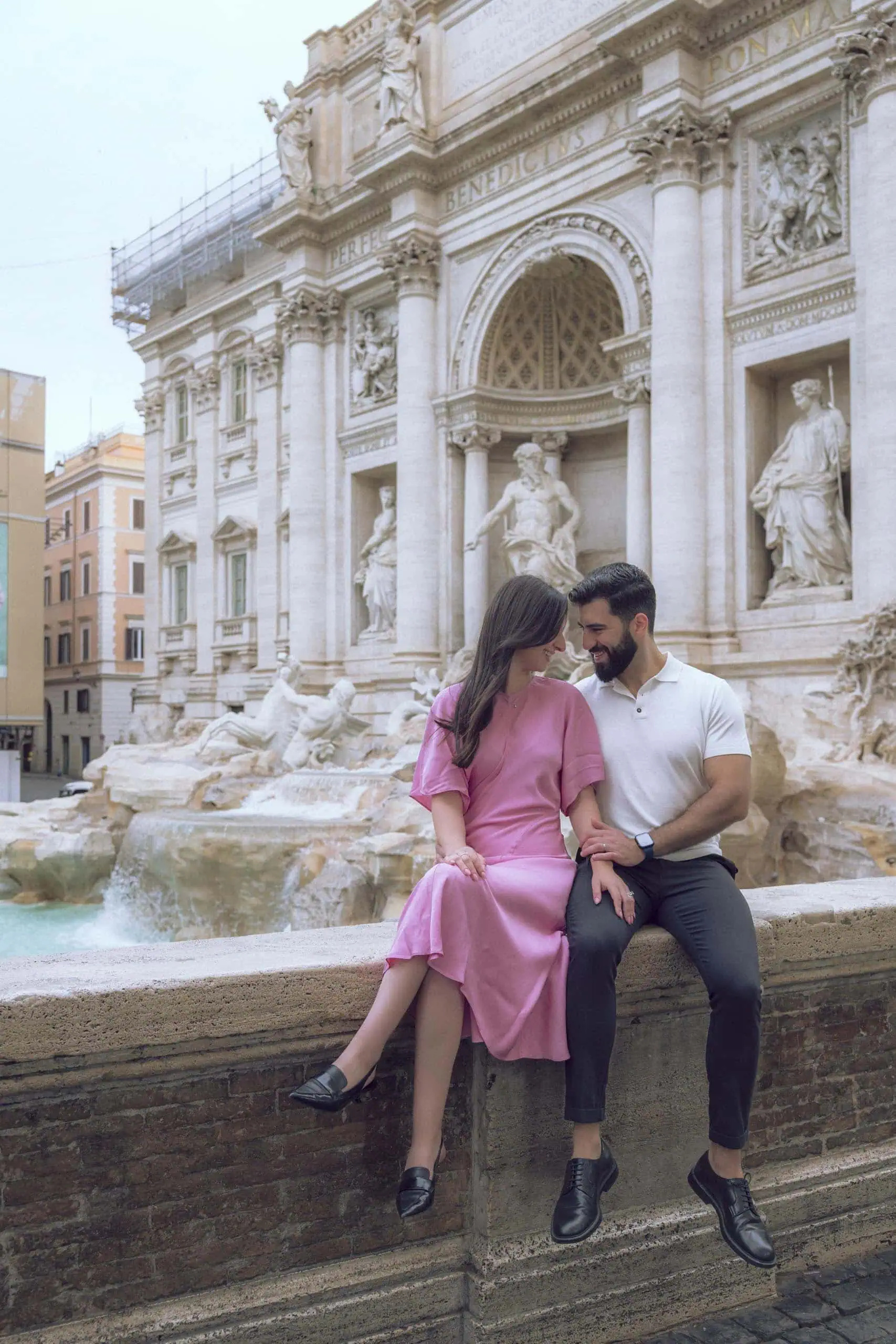
Outfit planning for outdoor sessions in Rome's cold season
For a winter photoshoot in Rome, wear a base layer, a mid layer, and a warm outer coat in neutral or earthy tones that complement the city's stone, terracotta, and winter light. This guide covers what to wear for an outdoor photoshoot in Rome between December and February. It is for anyone booking a session and wanting to arrive dressed for both the camera and the cold.
Rome winters are mild by northern European standards but genuinely chilly. Temperatures run between roughly 3°C and 12°C (37°F-54°F), wind picks up at open monuments, and rain is common. The right outfit solves all three problems at once, without sacrificing how you look in the photographs.
Rome's coldest months are January and February, with average highs around 12°C (54°F) and lows that can brush freezing overnight. December is milder but wetter: it is statistically the rainiest month of the year. According to weather data published by Climates to Travel (climatestotravel.com), winter in Rome runs from December to February and is mild but often cold at night, with sunny midday spells and lows that can reach 0°C. Snow is rare but not impossible.
Sessions involve walking between 3 and 5 km across cobblestone streets, open piazzas, and monument approaches. Wind at the Colosseum, the Roman Forum, and the Spanish Steps can make the air feel several degrees colder than the thermometer suggests. Fog is common in early January mornings but usually lifts by midday. Any outfit plan must account for movement, wind, and the possibility of light rain.
TipCheck the forecast 48 hours before your session. Light rain does not cancel a shoot. Heavy storms trigger a free reschedule.
| Package | Price | Duration | Photos | Locations |
|---|---|---|---|---|
| Essential | €300 | 1 hour | 30 photos | 1 location |
| Signature | €500 | 2 hours | 50 photos | 2 locations |
| Prestige | €800 | 3 hours | 60 photos | 3 locations |
Winter is the one season where the light almost always flatters. According to timeanddate.com, Rome's shortest day falls around December 21, with roughly 9 hours of daylight. That short arc means the sun stays low all day, producing the soft, angled light that photographers chase at golden hour in summer, but stretched across the entire morning and afternoon in winter.
The golden hour itself, defined as the roughly 60-minute window after sunrise and before sunset when the sun sits below 6° elevation, lasts longer in winter because of the sun's shallower trajectory. For a Rome session this means flattering light is available from mid-morning through early afternoon, not just at the edges of the day. The practical effect on clothing: you are not racing the clock the way you would be in summer, so you have more time to work with layers, adjust accessories, and change up the look between locations.
TipA night session in winter is particularly sharp: cold air reduces haze, monument lighting pops, and crowds are thinner than in summer.
The core principle is simple: visible layers are part of the outfit, not a concession to the cold. A well-chosen coat, a textured scarf, and a chunky-knit cardigan add visual depth to a photograph in a way that a single-layer summer dress cannot. Layers also give variety across a session without a full outfit change: open the coat, remove the scarf, and you have a noticeably different look in the same location.
Start with a thermal or fitted base layer, wool if possible, under whatever you intend to appear in on camera. This handles real warmth invisibly. The mid-layer is your main photographic garment: a coat, structured jacket, or sweater that you actually want to see in the images. Keep the outer layer windproof and ideally water-resistant for the walk between locations. For anyone wearing a skirt or dress, fleece-lined tights underneath are invisible in photographs and transformative for comfort. The session involves real walking, so footwear needs grip on wet cobblestones, not just style.
TipBring a warm coat to wear between shots even if it will not appear in the photographs. Staying warm between frames means relaxed shoulders and a natural expression when Finzi asks you to stop.
Rome in winter is a palette of warm ochre walls, dark travertine stone, grey skies, and occasional bare tree lines. Outfits that work against this backdrop tend to share one quality: they do not compete with the architecture. Deep jewel tones, camel, cream, burgundy, navy, and forest green all photograph cleanly against Rome's warm-stone surfaces. Bright white can be striking against a pale winter sky. Avoid patterns that are too busy or colours that are too close to the wall colours behind you, since mid-toned orange or terracotta will dissolve into the background.
For couples and groups, the simplest coordination approach is to choose one anchor piece, usually the most visually dominant coat or layer, then match the rest of the group to its tonal family. You do not need to be identically dressed. Two people in navy and burgundy read as coordinated; two people in identical beige coats read as staged. Mixing textures within the same colour family, wool, velvet, knit, adds dimension that flat, single-fabric outfits lose in photographs.
TipFinzi edits in a clean, modern style. Saturated neons and very bright florals can shift colour cast in post-processing. Stick to mid-range and deep tones for the most consistent result.
Winter accessories are active props in a Rome session, not just warmth tools. A well-chosen scarf adds motion, colour, and texture the moment you move. A structured hat changes the visual weight of a frame. Gloves matter for warmth between shots but should be pocketed when Finzi is shooting, since covered hands reduce connection in close portraits. For couples and groups, a shared accessory, two people in the same style of scarf or complementary hats, creates cohesion without matching outfits.
"One thing I notice every winter," Finzi says, "is that people pack the coat and forget the extras. A good scarf does more for a photograph than almost any single outfit choice. It moves, it frames the face, and it keeps you warm. Bring at least two so you have options."
TipSolid-colour or subtly patterned scarves work better on camera than very bold prints. The accessory should frame you, not distract from you.
Different Rome locations have different wind exposure, surface conditions, and backdrops, and outfit choices should match. The Colosseum and Roman Forum are fully open sites: wind is real, the ground is uneven stone, and footwear with grip is non-negotiable. Trastevere's narrow cobblestone streets are more sheltered and informal, suiting softer, more relaxed layers. The Spanish Steps are exposed and high-traffic; clean, structured outfits work better there than flowy pieces that move unpredictably in the wind. Piazza Navona and Villa Borghese offer cover from tree lines in winter.
The Signature and Prestige packages, covering two or three locations respectively, give room to adjust between locations. A structured coat for an open-air monument, then a softer layer and looser scarf for a Trastevere street, reads as intentional and varied across the delivered images. Finzi shoots at over 30 locations and will advise on pairings that make wardrobe sense as well as photographic sense.
TipIf you are booking a Prestige session across three locations, plan a subtle layer swap between stops. It reads as variety in the final gallery without requiring a full outfit change.
Groups introduce coordination challenges that solo and couple sessions do not have. The practical rule is to choose one person's primary layer first, usually the most prominent coat or outer garment, then build everyone else's colours and textures around it. This creates visual cohesion without dressing everyone identically. Children are a special case: they move constantly and cool down faster than adults. Layers that can be added or removed quickly are more useful than a single heavy garment.
For very young children, warm legs matter more than aesthetics. Thermal tights under trousers, or fleece-lined leggings under a skirt, keep them comfortable enough to cooperate. A cold child will not hold a pose. A warm child will. Finzi photographs families across Rome year-round and can accommodate quick wardrobe adjustments between locations. The walking distance per session is 3-5 km, so footwear for children should be practical before it is decorative.
TipPack a spare set of children's layers in a bag. Spills, rain, and general winter chaos happen. A dry change keeps the session on track.
Finzi offers four standard packages: Essential (1 hour, 1 location, 30 photos, €300), Signature (2 hours, 2 locations, 50 photos, €500), Prestige (3 hours, 3 locations, 60 photos, €800), and Proposal (1 hour, hidden camera, €300). Night sessions at €450 are available at locations such as the Colosseum and Trevi Fountain and are particularly effective in winter when cold air sharpens the monument lighting. A €30 non-refundable deposit locks the date. Rescheduling is free with no time limit.
Winter is low season for tourism in Rome. December, January, and February see significantly fewer visitors at the major monuments, which means cleaner backgrounds, fewer crowd-management adjustments during the shoot, and more flexibility in location timing. Images are delivered within 24 hours. Sessions are conducted in English.
TipBook 2-4 weeks in advance. Winter availability is more open than peak season, but specific date and time slots can still fill quickly around Christmas and New Year.
Quick answers to the questions visitors ask before they book.
“Finzi made us feel so comfortable and natural. The photos are absolutely beautiful and we received them the next day. Highly recommend!”
Pick a session. Choose a date. I handle the rest.
BOOK NOW