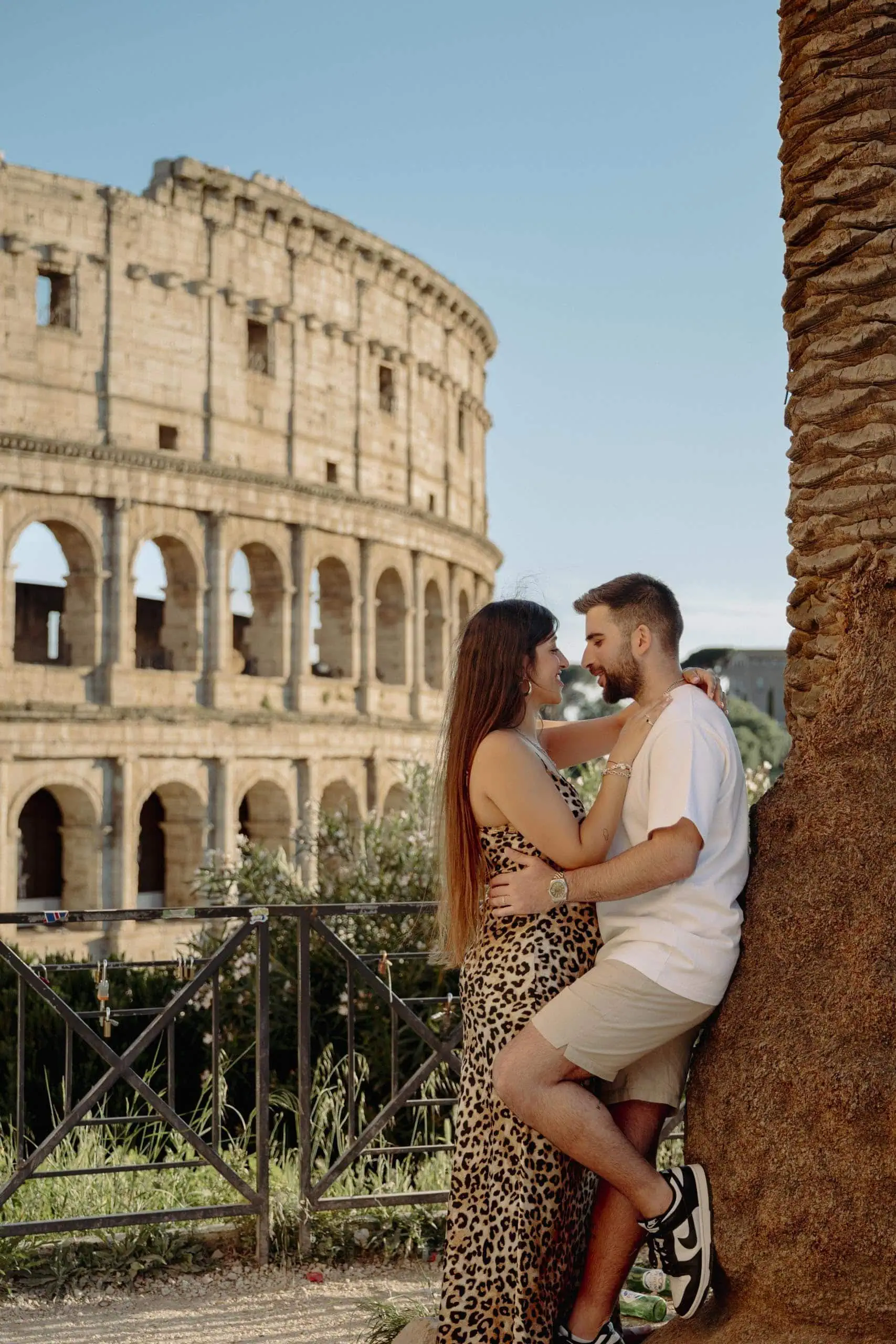
Golden hour, blue hour, and when to skip midday entirely
The best time of day for outdoor photos in Rome is the hour after sunrise or the hour before sunset, when low-angle light turns travertine stone warm gold, crowds are thinner, and shadows add depth instead of harshness. Both windows are real: morning golden hour runs roughly from sunrise for the next 40 to 60 minutes, evening golden hour starts roughly 40 to 60 minutes before sunset and the window shifts with every season.
This guide covers all four light windows available to you in Rome, what each one produces on camera, how crowd timing overlaps with light quality, and which Finzi session lengths fit each window. If you are choosing between sunrise and sunset, or wondering whether night sessions are worth it, you will find a direct answer here for every major Rome location.
Rome sits at latitude 41.9° north, meaning its sun arc is steep in summer and shallow in winter. That geometry determines everything about outdoor photos. According to time.now/rome, golden hour in Rome occurs twice daily: in the morning and in the evening, and "both windows move across the seasons." In August, evening golden hour starts well after 7 pm and the city is still bright past 8 pm. In December, that same window closes before 5 pm. Knowing your session date tells you exactly how much usable light you have.
At solar noon, the sun reaches its highest point directly overhead, producing near-vertical shadows, bleached highlights on white marble, and unflattering downward light on faces. The gap between a noon portrait and a golden-hour portrait is not subtle. It is the difference between squinting into flat glare and looking effortlessly at ease in warm, directional light. That difference is the entire reason professional session timing matters.
TipUse a free golden-hour calculator for your exact Rome travel date to lock in the window before you book.
| Package | Price | Duration | Photos | Locations |
|---|---|---|---|---|
| Essential | €300 | 1 hour | 30 photos | 1 location |
| Signature | €500 | 2 hours | 50 photos | 2 locations |
| Prestige | €800 | 3 hours | 60 photos | 3 locations |
Morning golden hour gives cool, soft, directional light that is slightly more neutral in tone than the evening equivalent. Crowds at almost every Rome landmark are at their lowest. Trevi Fountain, Piazza Navona, Spanish Steps, and the Pantheon can all be nearly empty. The trade-off is an early alarm and, in peak summer, a very early alarm. The reward is a combination of good light and empty piazzas that is genuinely impossible to replicate at any other time of day.
Evening golden hour is warmer, more amber, and typically longer in practice because summer daylight extends so late. This is the window most couples choose, partly because it aligns naturally with a day already spent exploring. The hour before sunset at locations like the Colosseum, Trastevere, and Pincio hill delivers light that catches every texture in stone and terracotta and wraps faces in warmth. Night sessions are a separate, specific category: the Colosseum and Trevi Fountain are floodlit and can produce dramatic results with a slow shutter and deliberate positioning, but they require different technical handling entirely.
TipIf you can only choose one: evening golden hour wins for warmth and flexibility across most Rome locations.
Mostly, yes, but not perfectly. Morning golden hour is the clearest win: light and crowds align in your favour at the same time. For open-air locations like Trevi Fountain and Piazza Navona, early morning is consistently the quietest window of the day. Evening golden hour is excellent for light but crowds are more variable. Tour groups begin thinning in late afternoon, and the last hour before sunset at the Colosseum often sees a marked drop in visitor density as day-trippers head back.
Midday is the convergence of the worst light and the worst crowds. At the Colosseum, sources consistently point to the window between roughly 11 am and 3 pm as the most congested and most photographically challenging. The stone holds heat, faces squint, shadows fall straight down, and every other visitor is there too. For a portrait session, midday is the one window I actively avoid building a session around.
TipWeekday mornings consistently beat weekends for both light and space at Rome's open-air sites.
Direction matters as much as timing. St. Peter's Basilica faces east, which means morning light floods and washes out the facade from the square; afternoon and evening light catches it from the west and produces depth and contrast. The Spanish Steps face west, making them a natural sunset location with warm light pouring down Via Condotti. The Colosseum faces roughly south-east, so morning light picks out its eastern face while late afternoon illuminates the west-facing arches dramatically. Villa Borghese and Pincio offer elevated westward panoramas that work best in the last hour before sunset.
Trastevere is a neighbourhood, not a single monument, and its narrow east-west cobblestone lanes channel golden light beautifully in both morning and evening windows. The Pantheon sits in a tight piazza where direct overhead light enters through the oculus at certain times of year, but for exterior portraits the soft diffused light of early morning, before the piazza fills, is the cleaner choice. I plan route order around light direction, not just location proximity, so that you are facing the best available light at each stop.
TipTell Finzi which locations matter most to you and the route will be sequenced to chase the right light at each one.
Rome's golden hour shifts dramatically across the year. In midsummer, evening golden hour can start past 7:30 pm and the sky does not fully darken until after 9 pm, giving plenty of room for a relaxed session without an early start. In December and January, that same window closes before 5 pm, so a Signature two-location session needs to begin earlier in the afternoon. Spring and autumn offer what many consider the ideal combination: golden hour lands at accessible times, temperatures are manageable for walking three to five kilometres, and the light carries a slightly cooler quality that suits a wide range of clothing colours.
Summer also brings haze on many days. Mediterranean summer heat creates atmospheric scattering that softens hard shadows during golden hour but can reduce the sharpness and contrast of the sky behind monuments. Autumn skies tend to be cleaner and blue hours more vivid. Winter offers the shortest day but also the longest shadow-to-monument ratio at golden hour, which can produce unusually dramatic architecture shots. Every season has a photographic argument in its favour.
TipSpring (April to May) and autumn (September to October) combine accessible golden-hour times with manageable session-day temperatures.
"I always ask two things before I confirm a session time: which locations do you want, and what is your priority, morning light or evening light," Finzi says. "The answer changes the route, the start time, and which side of each monument we stand on. That conversation takes two minutes and it changes the entire session." The practical result is that no two sessions start at the same time, because the right time depends on the date, the season, the locations chosen, and the light direction at each of them.
For an Essential session at one location, timing is clean: arrive 20 to 30 minutes before the golden-hour window opens, shoot through the peak of the light, and finish. For a Signature two-location session, the route is sequenced so the first location catches one phase of light and the second catches the follow-through. A Prestige three-location session may start at late afternoon and run into blue hour, or begin at sunrise and run through the full morning golden window. The session type does not fix the start time; the light does.
TipFree rescheduling is available with no time limit, so if weather or light conditions shift, you are not locked in.
Rome's most famous monuments are floodlit at night and the results can be genuinely compelling. The Colosseum takes on a warm amber glow after dark that is impossible to replicate in daylight. Trevi Fountain at night, with the illuminated water and deep blue sky behind the white marble, produces a colour contrast that stands apart from any daytime or golden-hour shot. Crowds thin significantly after dark at both locations, particularly later in the evening.
The night session is a different photographic approach, with longer exposures, careful positioning relative to the floodlights, and a deliberate use of the deep blue of the night sky as a background element. It works extremely well as a standalone session at one famous location, or as the second stop in a session that begins at evening golden hour and carries through into darkness. If the Colosseum or Trevi Fountain is central to your itinerary and you want something that looks distinct from a standard daytime image, the night option is worth serious consideration.
TipA night session pairs well with an earlier golden-hour walk in Trastevere if you want variety in a single evening.
If you have one location and want clean, no-compromise light, the Essential session at €300 gives one hour and 30 photos. Time it to the golden-hour window for your exact date and it is all you need. If you want two locations and the full arc from golden hour into dusk, the Signature session at €500 gives two hours and 50 photos across two locations. It is the most popular choice and the format that lends itself most naturally to a Rome evening that starts in warm light and ends in cool blue. The Prestige session at €800 spans three hours across three locations and can be structured to run from late afternoon through golden hour and into blue hour, or from sunrise through the full morning window.
A €30 deposit locks the date and all sessions include free rescheduling with no time limit. Images are delivered within 24 hours. I recommend booking two to four weeks in advance during peak season, April through October, when the overlap of good light and manageable crowds makes timing precision especially important.
TipPick a session. Choose a date. I handle the rest.
Quick answers to the questions visitors ask before they book.
“Finzi is an absolute professional. He knew exactly where to position us for the light and the photos came back within 24 hours. striking results.”
Pick a session. Choose a date. I handle the rest.
BOOK NOW