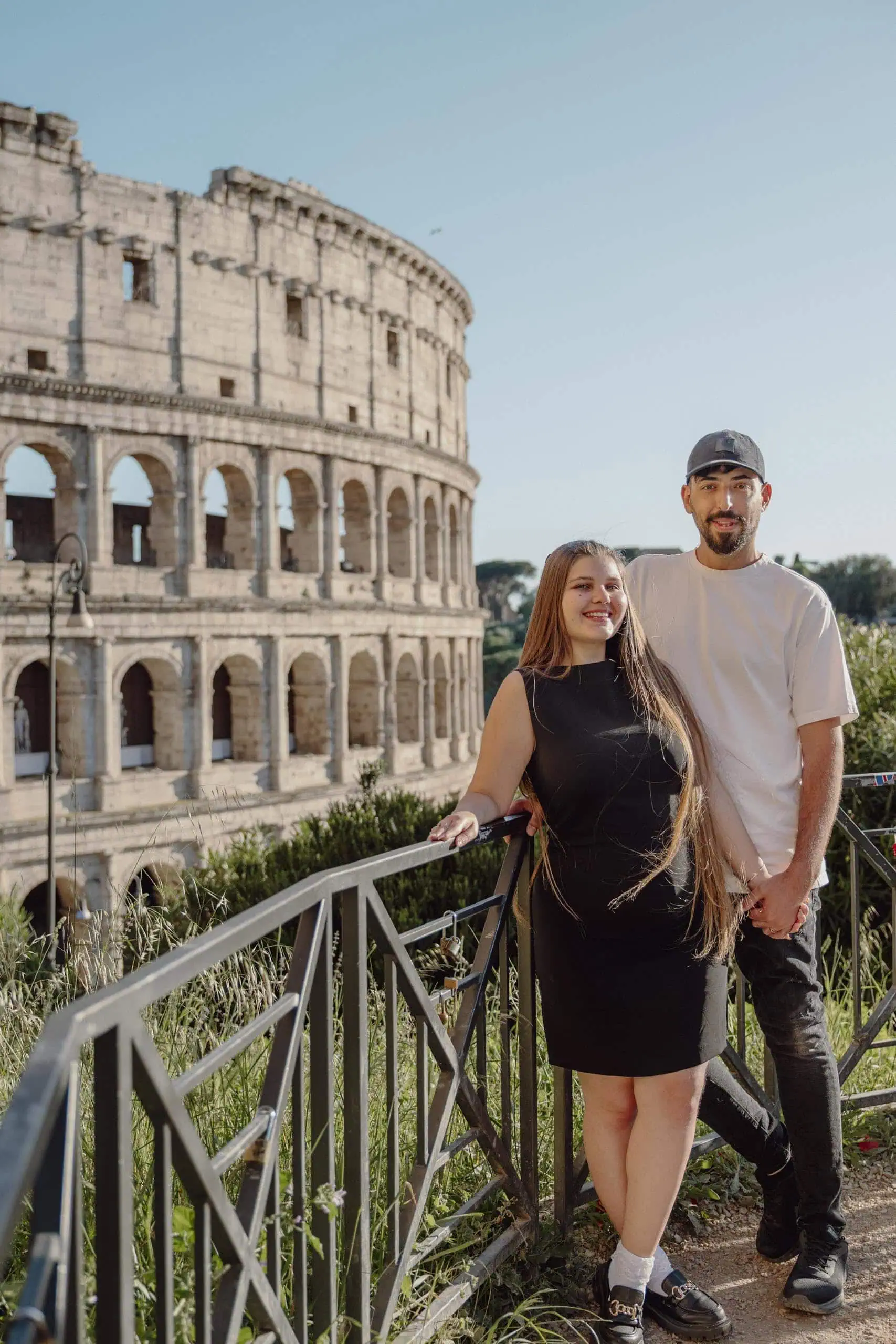
What Rome's rules actually require before any paid shoot begins
No. Commercial photography in Rome's public spaces requires a permit. The rule applies whether you are shooting for a brand, a paying client, or any use beyond personal memory-keeping. Rome has a dedicated municipal office, fees tied to the cultural value of each location, and a mandatory lead time of at least 20 days for most applications. Knowing where the line sits between 'tourist with a camera' and 'commercial photographer' determines whether your session runs smoothly or gets stopped.
This guide covers what counts as commercial photography under Roman and Italian rules, which spaces and landmarks have their own separate permit systems, what happens without paperwork, and how a session with a working Rome photographer fits into all of this. It is written for clients booking a portrait, proposal, or family session, not for production companies planning a commercial campaign.
The clearest official answer comes from the official tourism FAQ published by Turismo Roma, the Rome municipality's tourism arm: "to take photographs or videos in the city of Rome, unless they were for personal use, you need permission" submitted at least 20 days before the shoot. The keyword is 'personal use.' The moment a shoot has a paying client, a commercial purpose, or planned publication, it moves out of the personal-use category. The same Turismo Roma FAQ names the office that grants these permits as the "Authorisation Service for shooting films and taking photographs" run by Roma Capitale.
Roma Capitale runs a dedicated office called the Ufficio Autorizzazioni Riprese Cinematografiche e Fotografiche that handles authorisations and public-space concessions (COSP) for photographic and cinematic shoots across the city. This office manages both the space occupation permit and, where relevant, a separate image-rights fee charged by the Sovrintendenza Capitolina for shoots that involve Rome's protected cultural heritage. Two separate charges can apply for the same location.
TipTip: 'Personal use' means photos you keep for yourself. A paid session is not personal use under Rome's rules, regardless of who holds the camera.
| Package | Price | Duration | Photos | Locations |
|---|---|---|---|---|
| Essential | €300 | 1 hour | 30 photos | 1 location |
| Signature | €500 | 2 hours | 50 photos | 2 locations |
| Prestige | €800 | 3 hours | 60 photos | 3 locations |
The Colosseum, Roman Forum, Palatine Hill, Arch of Constantine, and Domus Aurea fall under the Italian State, not Roma Capitale. The city's own permit office states it is not the competent authority for these monuments: requests for shoots in the area of the Parco Archeologico del Colosseo must be submitted at least 30 days in advance through that park's own administration. That is a different process, a different body, and a longer lead time than the standard municipal permit.
Shoots inside museums or archaeological sites managed by the Sovrintendenza Capitolina that do not involve occupying public ground are handled by a separate heritage concessions office. Bridges over the Tiber, the Tiber embankments, and Isola Tiberina fall under regional jurisdiction. The Vatican is entirely independent of Roma Capitale and operates its own access rules. In practice, Rome's most famous backdrops each sit under a different authority, and most require dedicated paperwork.
TipTip: Piazza Navona, Spanish Steps, and Trevi Fountain sit under Roma Capitale's standard permit system, not the archaeological park authority.
Yes. Using a tripod is treated as occupying public ground under Rome's rules, which triggers the public-space concession requirement regardless of whether the photographer is amateur or professional. Roma Capitale's own permit service notes that the use of a tripod is equivalent to public space occupation and subjects the shoot to the standard authorisation process. A handheld camera in a public piazza used for personal travel photos sits in a different category. A tripod, lighting stand, or any equipment that claims ground changes that calculation.
Drone photography adds another layer. Rome, like most Italian cities, has strict no-fly zones over historical areas, and aerial shoots require separate approvals from aviation authorities in addition to any ground-level permits. This is relevant mainly for production-scale work rather than standard portrait sessions, but it is worth knowing if aerial coverage is part of a shoot plan.
TipTip: A compact handheld setup and a light-footed approach reduces both permit complexity and crowd disruption at any location.
Enforcement varies. A solo photographer working handheld among tourists is rarely stopped. A crew with lighting rigs, multiple assistants, and a tripod at a landmark will attract attention from site managers or local police. Without the correct paperwork, the outcome ranges from being asked to stop and move on to formal fines. Italy's rules on photography in spaces of historical and cultural significance are real, and a photographer working without proper paperwork can face consequences from the authority responsible for that specific site.
The more a session looks like a tourist moment, the lower the friction. The more it looks like a production, the higher the scrutiny. For a small portrait or proposal session, the physical footprint is minimal. No crew, no lighting, no set dressing. That does not make the session legally exempt if it is commercial, but it shapes the real-world experience. An experienced Rome photographer knows how each location behaves and plans accordingly.
TipTip: Experience at a location matters. A photographer who shoots the same piazzas hundreds of times knows exactly where to stand, how to move, and when to keep things quiet.
I have photographed hundreds of couples, families, and proposals across Rome's most significant locations. My approach is built around working efficiently within each location's real conditions. "I treat every location as its own set of rules," Finzi says. "What works at Piazza Navona is different from what the Colosseum area demands, and I plan each session around that reality, not around what would be convenient to ignore."
I work alone, handheld, and move with the session rather than against the location. I shoot at over 30 locations across Rome. When a session requires specific access or involves protected heritage in a way that demands formal clearance, that is part of the planning conversation before the date is confirmed. Pick a session. Choose a date. I handle the rest.
TipTip: Booking 2-4 weeks ahead gives time for any location-specific logistics to be sorted before your date arrives.
Every session is built around real Rome locations, managed from start to finish. The Essential (€300) covers one hour, one location, and 30 photos. The Signature (€500) covers two hours, two locations, and 50 photos. The Prestige (€800) covers three hours, three locations, and 60 photos. For proposals with a hidden camera, the Proposal session is €300. Night sessions, including the Colosseum and Trevi Fountain lit at night, are €450.
A €30 non-refundable deposit locks your date. Rescheduling is free and available anytime. All images are delivered within 24 hours. Sessions cover walking distances of 3 to 5 kilometres. Languages: English.
TipTip: The Signature session across two locations gives full flexibility to combine a landmark exterior with a quieter neighbourhood like Trastevere.
Quick answers to the questions visitors ask before they book.
“Finzi made the whole experience completely effortless. He knew every corner of Rome and where to go for the best light. The photos were delivered the next day and they are absolutely beautiful.”
Pick a session. Choose a date. I handle the rest.
BOOK NOW