What the rules actually are, location by location, and how Finzi handles it
The short answer is: it depends on the location, the equipment, and the purpose of the shoot. Rome draws a clear line between a photographer working discreetly in a public space and a production that occupies ground, blocks pedestrians, or involves tripods, lighting stands, or commercial intent. Most portrait sessions with couples, families, or solo travellers fall in the lighter category, but some spots require formal authorisation regardless of scale.
This guide covers the main landmarks across Rome, what the rules say at each one, what triggers a permit requirement, and what you can realistically expect on the day. If you are planning a session with me and wondering whether paperwork stands between you and the Colosseum or Trevi Fountain, read this first.
Italy treats areas of historical and cultural significance under a separate legal framework from ordinary public space. The practical distinction that authorities apply on the ground is this: a camera in your hands looks like tourism; a tripod, a light stand, an assistant, or repeated choreographed takes looks like a production. Equipment is the most visible trigger. The official Turismo Roma FAQ states that for photographs or videos in the city, "unless they were for personal use, you need permission" from Roma Capitale.
Roma Capitale, the official municipal authority of Rome, administers photographic authorisations through its Sovrintendenza Capitolina. Its official service page states that the permit covers shoots "all'interno di musei e aree archeologiche" (inside museums and archaeological areas) for editorial or advertising projects. The Roma Capitale Sovrintendenza Capitolina also specifies that applications must be submitted at least 30 days before the shoot date. This 30-day threshold matters practically: if you are planning ahead, that window is very achievable. If you are booking a week out, it is not.
The key variables that push a session into permit territory are: use of a tripod (Roma Capitale explicitly states that using a tripod is equivalent to occupying one square metre of public ground), commercial or advertising intent, and whether the shoot takes place inside a fenced or ticketed archaeological area rather than on the surrounding public piazza.
TipShooting without a tripod, without assistants, and without lighting equipment is the simplest way to keep a portrait session in the clearly permitted zone at most open public spaces.
| Package | Price | Duration | Photos | Locations |
|---|---|---|---|---|
| Essential | €300 | 1 hour | 30 photos | 1 location |
| Signature | €500 | 2 hours | 50 photos | 2 locations |
| Prestige | €800 | 3 hours | 60 photos | 3 locations |
Open public piazzas, including Piazza Navona, the area around the Pantheon, Trastevere's streets, and the Spanish Steps, are publicly accessible space. A photographer working there with a handheld camera, shooting portraits of clients who look like visitors, does not generally require a permit. The moment equipment appears, especially a tripod or a portable reflector large enough to require a second person to hold it, the activity can be interpreted as occupying public ground, which triggers a separate authorisation.
The Colosseum, Roman Forum, and Palatine Hill sit inside the Parco Archeologico del Colosseo, which is state-managed, not municipal. Roma Capitale itself notes on its official permit page that "l'Amministrazione Capitolina non è competente per autorizzazioni relative a monumenti statali, come il Colosseo, Domus Aurea, Arco di Costantino, Foro Romano e Palatino" (the municipal authority is not competent to authorise shoots at state monuments). Any formal production inside those sites goes through the Parco Colosseo, not the city. For a handheld portrait session outside the perimeter walls, on the public streets and piazzas surrounding the Colosseum, no permit is required.
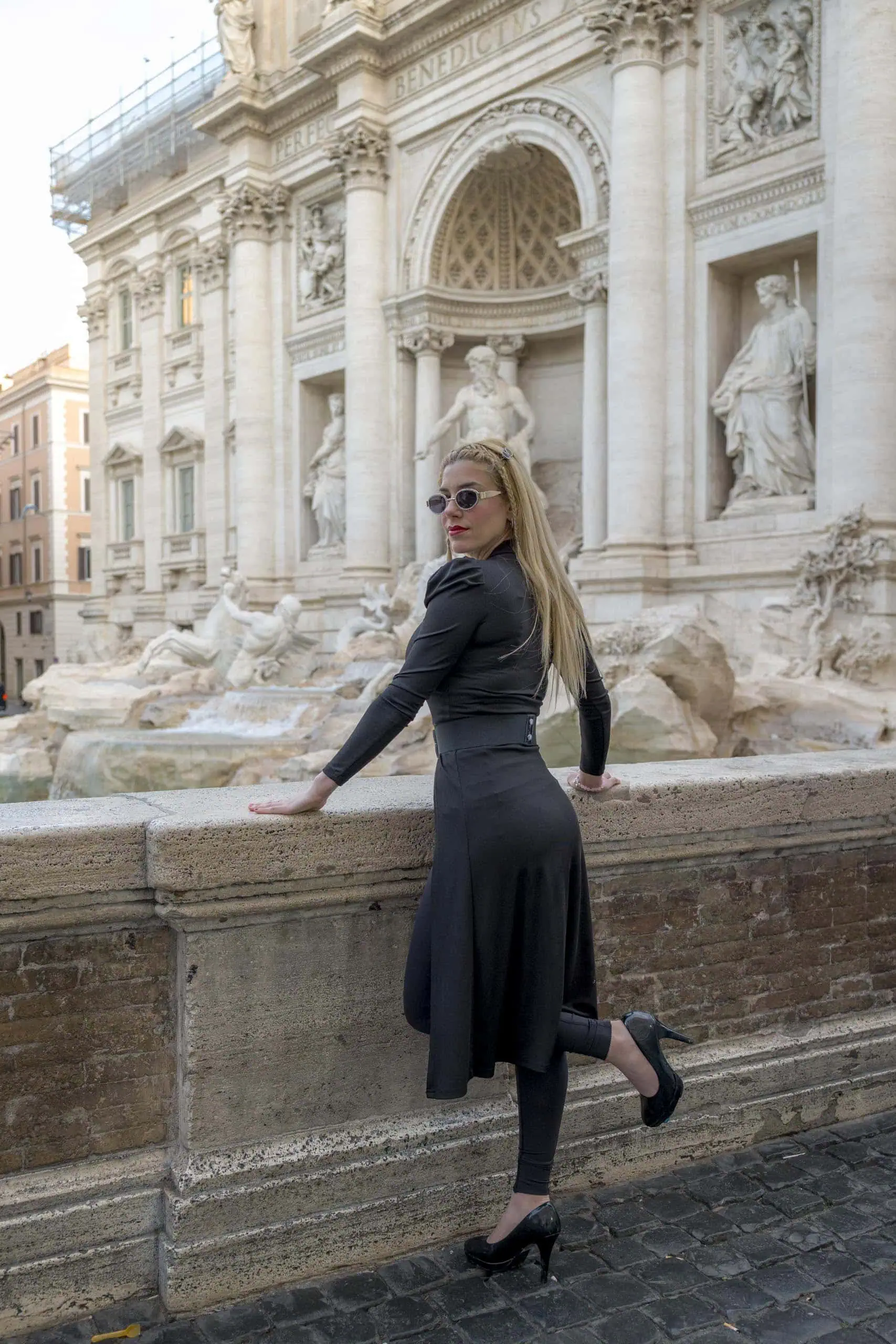
The Trevi Fountain now operates under a ticketed access system introduced in early 2026. Getting close to the fountain during regulated hours requires purchasing an entry ticket. This applies to every visitor, photographer or otherwise. It is an access rule, not a photography permit. Once inside the access zone, standard photography of the kind a visitor would do is permitted. Tripods remain impractical here for separate reasons: the space is narrow, crowded, and the area around the basin is monitored.
TipThe perimeter around the Colosseum, especially the Via Sacra side and the arches facing the Forum, gives strong architecture in the frame without requiring entry into the ticketed archaeological zone.
The three factors that most reliably push a shoot into formal permit territory are equipment, crew size, and commercial purpose. A single photographer with a mirrorless camera or DSLR and no additional gear is operating close to the tourist baseline. Add a tripod and you have occupied public ground. Add a reflector requiring a second person and you have a crew. Add a light stand and you have a production. Add advertising or commercial licensing to the deliverables and every heritage authority in Rome will want to see paperwork before you start.
For the kind of portrait session that most visitors book, which is a photographer, a couple or a family, moving between locations and shooting in natural light with handheld equipment, none of those triggers apply. The session reads as personal photography, not commercial production. Italy's heritage rules are specifically calibrated for editorial and advertising work. A set of holiday portraits, proposal photographs, or anniversary images does not fall into that category under standard interpretation.
Drone photography is a separate matter entirely. Drones are heavily restricted across Rome's historic centre and the airspace over monuments such as the Colosseum, Vatican, and Pantheon. This type of aerial photography requires authorisation from civil aviation authorities and from the relevant site operators. No session I offer involves drones. All my work is ground-level.
TipNatural light, a single photographer, and a small group moving at visitor pace: that combination avoids every equipment-based trigger at Rome's open public landmarks.
I work alone. No assistants, no lighting rigs, no tripods. I carry one camera, move through each location the way a visitor would, and shoot in natural light throughout. That approach is deliberate, not accidental. It keeps the energy relaxed, keeps the session invisible to the crowds around us, and keeps the images looking natural rather than staged. It also means that at every open public location across Rome, including Piazza Navona, Trastevere, the Spanish Steps, the streets around the Colosseum, and Villa Borghese, we are working cleanly within the rules without any additional process.
"I shoot without a tripod at every location," Finzi says. "One camera, natural light, and we move. The session looks like two friends walking through Rome, not a photoshoot, and that is exactly what makes the photos work." That working method is also why clients do not need to coordinate any paperwork before we meet. For the 30-plus locations I shoot across Rome, the session structure I use does not trigger permit requirements at open public spaces.
Sessions that include interior heritage sites, such as parts of a church or a museum gallery, involve different rules that depend on the specific institution. In those cases, I discuss what is and is not accessible in advance of booking. I do not offer sessions inside the Colosseum arena floor or inside the Roman Forum's ticketed zone as part of standard packages, so those state-monument authorisations are not in scope for what you are booking here.
TipIf you have a specific location in mind that you are unsure about, ask before booking. I will tell you directly what is and is not accessible for your session type.
Yes, but not in the way most people assume. The ticket introduced in early 2026 covers access to the inner area close to the fountain, not photography rights specifically. Everyone who wants to approach the basin during regulated hours pays for access. For a photoshoot, the practical effect is that you and I both enter as ticketed visitors. We shoot in the access zone like any visitor would. The ticket does not restrict the photography itself.
The more significant practical constraint at Trevi is crowd density and the narrowness of the space. Sunrise, before access regulation kicks in, remains the best window for a less crowded frame. I also offer dedicated Night Sessions where the fountain is lit beautifully and the atmosphere is very different from the daytime. At night the space clears considerably and the water and illumination create a quality of light that midday simply cannot match.
Sitting on the basin edge is now explicitly prohibited under the rules the city introduced alongside the ticketing system. That one is straightforward to work around: the fountain's sculptures, the surrounding architecture, and the approach lanes all offer strong framing without needing to place anyone on the edge.
TipA Night Session at Trevi gives you the fountain fully lit, far fewer people, and light that photographs in a completely different register from any daytime frame.
If permits are not a barrier at your chosen locations, the decision becomes about time, locations, and how many images you want to bring home. The Essential session covers one location in one hour and returns 30 photos, at €300. The Signature session, the most popular option, covers two locations in two hours and returns 50 photos, at €500. The Prestige session covers three locations in three hours and returns 60 photos, at €800. For a proposal, there is a dedicated Proposal session at €300 that uses a hidden camera approach for one hour at one location.
For visitors specifically asking about the Colosseum area, Trevi Fountain, and one other landmark in the same session, the Signature or Prestige packages are the practical fit. Two or three locations across Rome typically involves walking three to five kilometres, so comfortable shoes matter as much as anything else you plan for the day.
A €30 deposit secures your date. Reschedules are free and available anytime, with no time restrictions. Delivery is within 24 hours of the session. Book at least two to four weeks out during peak season, April through October. Last-minute bookings are sometimes possible, so contact me directly to check availability.
TipThe Signature package covers the Colosseum area and Trevi Fountain in a single session, which is the combination most visitors ask about when planning around permits and access.
Quick answers to the questions visitors ask before they book.
“Finzi is absolutely incredible. He made us feel so comfortable and natural the entire session. The photos came back the next day and we were blown away. Booking him was the best decision of our trip to Rome.”
Pick a session. Choose a date. I handle the rest.
BOOK NOW