What you can and cannot bring to Rome's major sites
Tripods are banned at most of Rome's major monuments and museums, including the Colosseum, Roman Forum, Vatican Museums, Galleria Borghese, and Capitoline Museums. The rule applies whether you are shooting for personal memory or a professional session. If you are planning a photoshoot in Rome, this guide covers where tripods are explicitly prohibited, where enforcement is stricter, what counts as professional gear in the eyes of site staff, and how I work around every restriction to deliver clean, edited images within 24 hours.
This matters most if you are arriving with a large camera bag, expecting to set up equipment at the Trevi Fountain, or planning a session around sunset near the Colosseum. The rules are real, they have tightened in recent years, and knowing them before you arrive saves wasted time and avoids being asked to leave.
No. Tripods are explicitly prohibited at both the Colosseum and the Roman Forum and Palatine Hill. According to canibring.it, which tracks official venue policies, the Colosseum bans tripods as professional optical and audio equipment under Article 9.7 of its visitor regulations, covering "tripods, cameras, microphones, audio mixers, etc." without formal authorization. The Roman Forum and Palatine Hill carry the same prohibition under the same article, requiring written authorization from the Park Direction. The same ban extends to the Vatican Museums, where, according to the Vatican Museums official visitor information, "the use of tripods, stands, drones and/or professional equipment is not allowed" without authorisation from the Directorate of the Museums and Cultural Heritage.
The reason is straightforward: the Colosseum is crowded, the corridors are narrow, and the surfaces are uneven. A tripod blocks visitor flow, creates a safety hazard near open drops along the upper tiers, and risks contact with ancient stonework. Staff will ask you to remove it. For a portrait or travel session at these sites, a handheld or shoulder-supported camera delivers every shot you need.
TipLeave the tripod at your hotel. A skilled photographer does not need one to produce sharp, well-composed images at these sites.
| Package | Price | Duration | Photos | Locations |
|---|---|---|---|---|
| Essential | €300 | 1 hour | 30 photos | 1 location |
| Signature | €500 | 2 hours | 50 photos | 2 locations |
| Prestige | €800 | 3 hours | 60 photos | 3 locations |
The ban extends across every major indoor site in Rome. The Vatican Museums and Sistine Chapel prohibit tripods, stands, and drones; the official policy states that tripods and camera stands must be left in the cloakroom on arrival. The Galleria Borghese bans all photography with tripods or stands unless the user holds a formal reproduction concession. The Capitoline Museums allow photography only without tripods, selfie sticks, or supplementary lighting. The Galleria Doria Pamphilj permits tripods only for an officially authorized photographic service.
The pattern across every site is consistent: handheld personal photography is welcome, and anything that requires setting up equipment, occupying floor space, or implying commercial intent triggers a permit requirement. If you are visiting these museums and want good photographs of yourself in them, a compact camera or phone, held at arm's length or handed to a companion, is the only practical option inside.
TipSelfie sticks fall under the same gear restrictions at most of these sites. Do not count on bringing one inside.
Open public streets and piazzas in Rome carry no blanket ban on tripods for personal, non-commercial photography. Locations such as Trastevere's cobblestone lanes, the Gianicolo terrace, Pincio hill, and the outer perimeter around the Colosseum are public space. Setting up a small travel tripod in these spots for a personal shot is generally tolerated, particularly at quieter hours. The practical limit is crowd density: the area immediately around the Trevi Fountain is dense enough that a tripod becomes a hazard to other pedestrians regardless of any formal rule.
"Depending on the monument, time of day, and whether police are around, using a tripod can solicit a request for permits," as noted by seasoned forum contributors covering Rome. The Trevi Fountain has introduced additional access controls since early 2026, and the square itself is packed from mid-morning onward. For a portrait session at the fountain, early morning before regulated access hours begins is the only window where the space is calm enough for deliberate photography, with or without a tripod.
TipQuieter open-air sites like Circus Maximus and the Aventine keyhole garden impose no tripod restrictions and reward early arrivals.
As of February 2026, close access to the Trevi Fountain requires a paid entry ticket for non-residents and tourists. The ticket system was introduced by Rome mayor Roberto Gualtieri to control overcrowding. Viewing from a distance remains free, but anyone who wants to approach the monument for close-up photography must purchase a ticket. The regulated access hours run from 9 a.m. to 10 p.m. on most days, and from 11:30 a.m. on Fridays. Outside those hours, the fountain is freely accessible to everyone.
For a photography session at the Trevi Fountain, arriving before regulated hours opens is the cleanest solution. The space is quiet, the light is softer in the early morning, and there is no queue for the inner area. Sitting on the basin edge is also no longer permitted under the updated rules. These are logistical factors I account for when planning any session that includes the fountain.
TipBook an early-morning or night session at the Trevi Fountain to sidestep both the ticket queue and the crowd.
Rome's sites draw the line at equipment that requires setup, occupies space, or signals commercial intent. A tripod is the clearest marker, but the same logic applies to light stands, reflectors, external flash units mounted on stands, light diffusers, drones, and audio equipment. A camera body with a lens, held in hand, is personal photography everywhere. The moment a second person is clearly directing the shoot or equipment is deployed on the floor, staff treat it as a professional or commercial session requiring authorization.
"I work without a tripod or additional lighting at every Rome location," Finzi says. "Modern full-frame cameras at high ISO with fast lenses produce clean results in any ambient light. The gear I carry is compact enough to walk 3 to 5 km across sessions and never draws attention from site staff. That is a deliberate choice, not a limitation."
TipA mirrorless body and two primes fit in a shoulder bag and draw zero scrutiny. That setup covers every location in Rome.
Most of Rome's churches allow personal photography without flash but ban tripods as a matter of standard practice. St. Peter's Basilica permits photography in most of its interior but the Vatican Museums complex, which includes the Sistine Chapel, enforces a strict no-tripod and no-stand policy from the entrance checkpoint. Smaller basilicas such as Santa Maria Maggiore and San Giovanni in Laterano generally tolerate a discreet handheld camera but will ask visitors to stop if equipment is deployed or if photography disrupts an ongoing service.
The practical rule for churches: shoot handheld, avoid flash, be quiet and quick, and never set anything on the floor. Church staff have full discretion to ask any visitor to stop photographing. Tripods in a church are almost always refused on first challenge, regardless of permit status.
TipThe best architectural light in most Roman churches falls in mid-morning through early afternoon, when high windows angle sunlight across the nave.
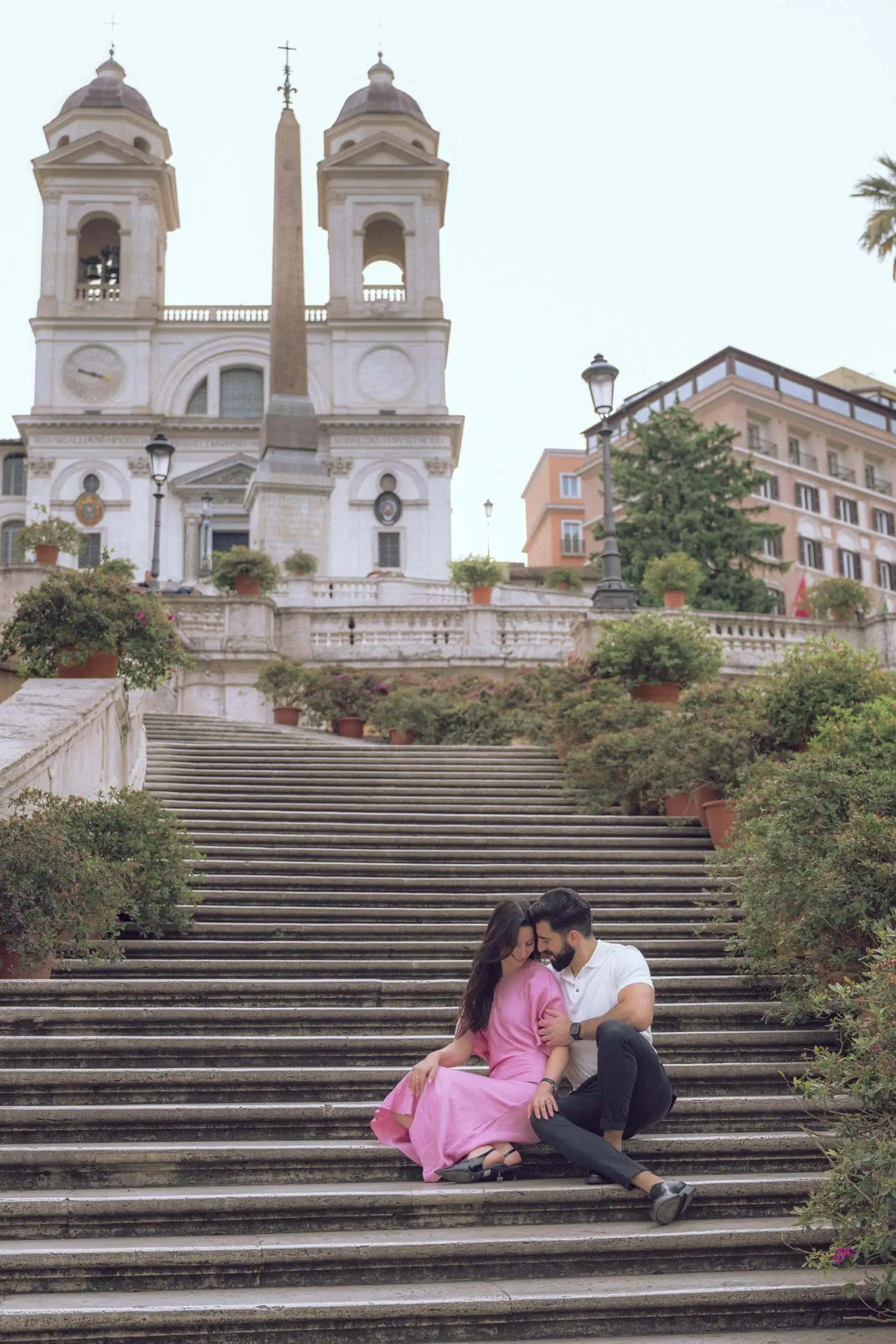
I shoot at over 30 locations across Rome, including the Colosseum, Trevi Fountain, Vatican, Roman Forum, Piazza Navona, Villa Borghese, Trastevere, Spanish Steps, and more. None of those sessions require a tripod to produce results that have appeared in Vogue and Leica Galleries. The entire workflow, from first frame to delivered gallery, runs on ambient light, fast primes, and positioning. I edit every image myself and deliver within 24 hours.
When a session includes a site with restricted access or gear rules, I plan around timing rather than equipment. Early morning gives the Trevi Fountain soft, crowd-free conditions. Golden hour at the Colosseum exterior is open street. Night sessions at the Colosseum and Trevi Fountain work because the monuments are lit and the crowds are thinner, not because of any tripod. The logistics are handled before you arrive. Pick a session, choose a date, I handle the rest.
TipFree reschedule is available anytime. A €30 deposit locks your date.
Quick answers to the questions visitors ask before they book.
“Finzi made the whole shoot effortless. He knew exactly where to position us, managed the crowds perfectly, and delivered striking photos the next day. Highly recommend.”
Pick a session. Choose a date. I handle the rest.
BOOK NOW