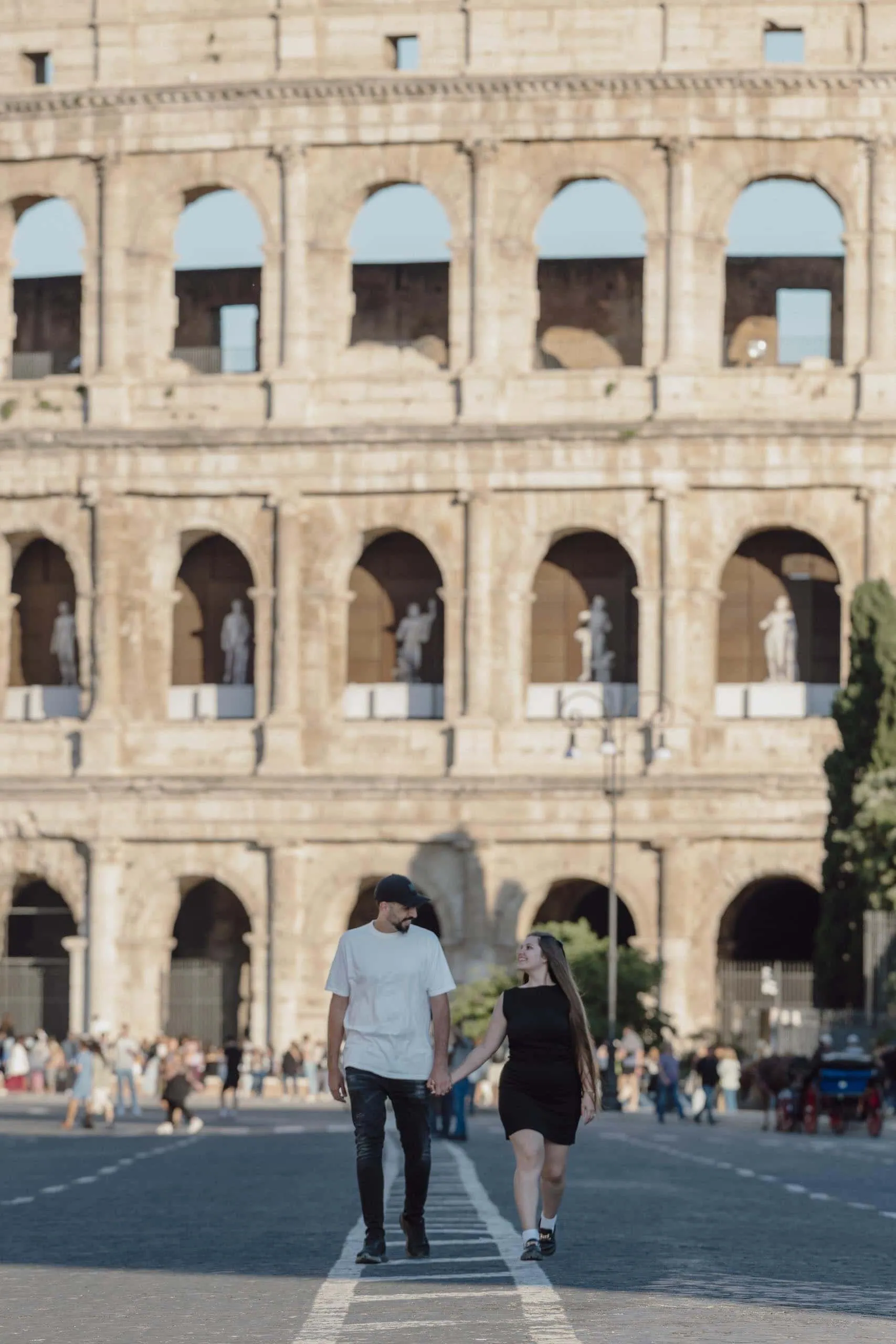
What Rome's permit rules actually mean for your session in 2025
For most portrait and travel photoshoots at the Colosseum exterior or the Trevi Fountain, no advance permit is required. The distinction that matters is commercial versus personal photography, and whether you are shooting inside a ticketed archaeological site or on a public piazza. This guide breaks down both locations, explains the practical differences, and tells you exactly what to expect when you arrive with a professional photographer.
I shoot at both locations regularly. The rules are manageable once you know them, and the most common question clients ask me turns out to have a simpler answer than they feared.
Italy draws a clear line between personal photography and commercial photography. Personal photography covers portraits, family sessions, couple photos, proposals, and travel memories where the images are kept privately or shared on personal social media. Commercial photography means the images are produced for advertising, editorial publication, product licensing, or paid media. Portrait sessions for private clients fall firmly in the personal category, even when a professional photographer is being paid for their time. Under Article 108 of Italy's Code of Cultural Heritage and Landscape, as the AIPPI notes, "non-profit uses of cultural heritage items for purposes of study, research, freedom of expression or creative expression" do not require authorisation.
This distinction matters because it determines whether advance paperwork is required at all. The vast majority of photoshoots that visitors book in Rome, including every session I run, are personal portrait sessions. They do not trigger commercial permit requirements. Where things change is when a production brings lighting rigs, multiple assistants, or equipment that alters public space, or when images are destined for paid advertising campaigns. Those productions require separate authorisation from Rome's municipal authority.
TipIf your session is a portrait, couples, proposal, family, or honeymoon shoot, you are in the personal category. No paperwork needed.
| Package | Price | Duration | Photos | Locations |
|---|---|---|---|---|
| Essential | €300 | 1 hour | 30 photos | 1 location |
| Signature | €500 | 2 hours | 50 photos | 2 locations |
| Prestige | €800 | 3 hours | 60 photos | 3 locations |
Outside the Colosseum, on the Piazza del Colosseo and the surrounding streets, photography is unrestricted for personal sessions. No permit, no prior application, no fee beyond your standard entry if you go inside. The Parco Archeologico del Colosseo is the official body that manages the site, and its visitor guidelines confirm that commercial shoots require prior permission from the park administration, while personal photography is permitted freely.
Inside the Colosseum, the same personal-versus-commercial rule applies, but with additional equipment restrictions. Selfie sticks and standard tripods are not permitted anywhere inside the structure. Drones are strictly prohibited across the entire archaeological zone. For a professional portrait session, none of these restrictions are a practical problem: I work handheld, move with my clients, and use available light. The results are consistent regardless.
TipThe exterior of the Colosseum is where I frame most portrait sessions. The scale of the arches reads dramatically even from the pavement, and there is no entry ticket involved.
The Trevi Fountain sits on a public piazza managed by the Comune di Roma, and no photography permit is required for personal sessions. What has changed recently is access itself. Starting in early 2026, a ticketed entry system was introduced for close access to the fountain during set daytime hours. Visitors can still view the fountain from a distance without charge, but approaching the monument for close-up photographs during those hours requires purchasing an access ticket. The rule applies to all visitors regardless of whether a photographer is present.
For photoshoots, this means the planning question shifts from permits to timing and access. Arriving before or after the ticketed window gives completely free access with no queue and, more importantly, far fewer people in frame. I offer night sessions at the Trevi Fountain for exactly this reason: the fountain is lit beautifully after dark, the access restrictions do not apply in the same way, and the atmosphere is completely different from peak daytime hours.
TipEarly morning before the ticketed window opens gives the cleanest light and the emptiest piazza. Night sessions offer the lit fountain against a dark sky, a completely different visual result.
The equipment you bring into a public space or monument is a key factor in how Rome's rules apply. Tripods are the most commonly flagged item: they are not permitted inside the Colosseum, and setting up a tripod in a congested public piazza can attract attention from site security. Large lighting setups, reflectors on stands, and anything that physically occupies public space or blocks pedestrian flow can move a session from the personal category toward one requiring authorisation.
For my sessions, none of this is a constraint. I shoot without tripods, without supplementary lighting rigs, and without assistants occupying the space around us. That is a deliberate choice: it keeps the session mobile, low-profile, and natural. Clients are not standing in a production setup. They are simply moving through Rome while I document them. The result is more honest, and it keeps us well within the rules at every location.
Crowds are the real operational challenge at both the Colosseum and the Trevi Fountain, not permits. The Colosseum exterior is busy from mid-morning onwards throughout the year. Arriving early, before the tour groups and the main visitor wave, gives cleaner backgrounds and softer morning light. Golden hour, in the last forty minutes before sunset, wraps the travertine arches in warm amber and is one of the most consistently beautiful light windows anywhere in Rome. I also offer dedicated night sessions at the Colosseum, when the monument is floodlit and the piazza quietens considerably.
At the Trevi Fountain, the crowd rhythm is relentless during peak daytime hours. Night is the practical solution for anyone who wants the fountain without a wall of visitors in the background. The floodlights bring out the detail in the Bernini sculptural work in a way that flat daytime light does not. "I plan every Trevi session around the light and the crowd window, not around a clock," Finzi says. "Night shoots there are often the ones clients talk about longest."
TipBook at least 2-4 weeks ahead during April to October. Last-minute dates are sometimes available; contact me directly to check.
I photograph at both the Colosseum and the Trevi Fountain regularly, across all session types: couples, proposals, families, honeymoons, anniversaries, and solo portraits. The Essential package covers one location in one hour with 30 photos. The Signature package covers two locations in two hours with 50 photos and is the most popular choice for clients who want both the Colosseum and the Trevi Fountain in one session. The Prestige package covers three locations in three hours with 60 photos. All sessions include free rescheduling with no time limit, and photos are delivered within 24 hours.
Proposals at the Trevi Fountain use a hidden-camera approach: your partner has no idea I am there until the moment has passed. The Proposal session is built specifically for that format. For couples who want to combine a proposal at the Trevi Fountain with portraits at the Colosseum, the Signature or Prestige package covers both. A €30 deposit secures the date; the balance is settled separately.
TipFree rescheduling is available anytime, with no deadline or time limit attached.
No permit is required for personal portrait sessions at the Colosseum exterior or the Trevi Fountain piazza. The Parco Archeologico del Colosseo states that commercial shoots require prior permission from the park administration, while personal photography is unrestricted. For the Trevi Fountain, the change introduced in 2026 is a daytime access ticket for close proximity to the monument, not a photography permit. After 21:00, access is free with no restriction.
The situations that do require formal permits are commercial productions with advertising intent, shoots using lighting rigs or equipment that occupies public space, or any interior filming arrangements at the Colosseum that go beyond standard visitor photography. For the portrait sessions I run daily across Rome, none of those conditions apply. The rules are clear, the locations are accessible, and the only real planning variable is timing.
Quick answers to the questions visitors ask before they book.
“Finzi was fantastic from start to finish. He knew exactly where to position us near the Colosseum and the photos arrived the next day. Absolutely worth every moment.”
Pick a session. Choose a date. I handle the rest.
BOOK NOW