What to do before, during, and between shots so your Rome photos feel real
Looking natural in photos comes down to three things: movement over stillness, a photographer who guides rather than counts, and choosing Rome locations that give your body something real to interact with. This guide covers what you can do before the session, what happens during it, and which Rome settings make relaxed, unposed images easiest to achieve.
Most people arrive at a photoshoot convinced they are not photogenic. They almost always leave with a gallery they love. The difference is not talent in front of a camera. It is knowing what to do with your hands, when to breathe, and why walking through Trastevere produces better results than standing in front of a monument waiting for a shutter click.
The moment a camera appears, most people freeze. Shoulders rise, jaws tighten, and smiles lock into position. That tension reads directly in the final image. The fix is not a better pose. It is a full reset before the shutter fires: drop your shoulders, unclench your jaw, take one slow breath out. That single sequence changes the entire frame. According to the Parco Archeologico del Colosseo, visitors can move freely through "the Palatine Hill, Roman Forum, and Colosseum area", open-air historic spaces that naturally encourage walking, pausing, and letting the body settle between frames.
Standing square to the camera is the most common mistake. Shifting your weight onto your back leg and angling your body slightly to one side creates a natural line without any visible effort. The same applies when two people are photographed together: turning slightly toward each other, rather than side by side facing forward, produces warmth and depth that a frozen front-on frame never will.
TipPractice the exhale at home in a mirror: shoulders down, jaw loose, weight on one foot. It takes about ten seconds and pays off in every frame.
| Package | Price | Duration | Photos | Locations |
|---|---|---|---|---|
| Essential | €300 | 1 hour | 30 photos | 1 location |
| Signature | €500 | 2 hours | 50 photos | 2 locations |
| Prestige | €800 | 3 hours | 60 photos | 3 locations |
Being guided does not mean being told to stand somewhere and smile. It means getting small, specific prompts that give your body something real to do: walk slowly toward a doorway, glance back over your shoulder, adjust the collar of your jacket. These micro-actions produce natural movement, and natural movement is where the best frames happen. "I never count to three," Finzi says. "I give you something to do, then catch you doing it. That is the entire method."
The prompts differ depending on the session. On a couples session, I might ask the two of you to walk ahead of me and talk about anything, your plans for dinner, a joke from the trip, whatever keeps you actually talking. On a solo session, the prompt might be as simple as looking at the building above you and then back down. The movement lasts two or three seconds. The camera catches the in-between moment, and that is the image that looks effortless.
TipYou do not need to practice posing before the session. Just show up comfortable and ready to move.
Hands and facial expressions are where most people's self-consciousness concentrates. For hands: keep them in motion between frames. Sliding one hand into a pocket, holding your partner's hand mid-walk, or touching your collar lightly all give hands a purposeful position without looking placed there. Rigid, straight-armed hands at the sides are the one thing to actively avoid. Everything else works.
For expressions: the most natural smiles come just after a laugh, not during a held smile. Recalling a specific funny moment from the trip right before the shutter fires produces the eye crinkle that distinguishes a genuine expression from a posed one. If you prefer a quieter, more considered look, the approach is the opposite: look slightly away from the camera, soften your gaze, and let your expression settle before the frame is taken. Both work. Mixing them across a session produces a gallery with real range.
TipSaying 'cheese' produces a held smile. Saying nothing and letting a real thought pass across your face produces the frame you will print.
Locations that give you something to interact with produce the most natural results. Trastevere's narrow cobblestone streets, ivy-draped walls, and small piazzas encourage walking, turning corners, and looking around genuinely, because there really is something worth looking at around every corner. That curiosity reads as ease in the photos. Villa Borghese works similarly: the park's long garden paths, open lawns, and quiet lakeside areas at Pincio give a session room to breathe and move. The Galleria Borghese notes that the surrounding gardens are open to the public as a free park, stating they offer visitors "an experience of art, nature and history" within the park grounds, making them one of Rome's most relaxed outdoor settings.
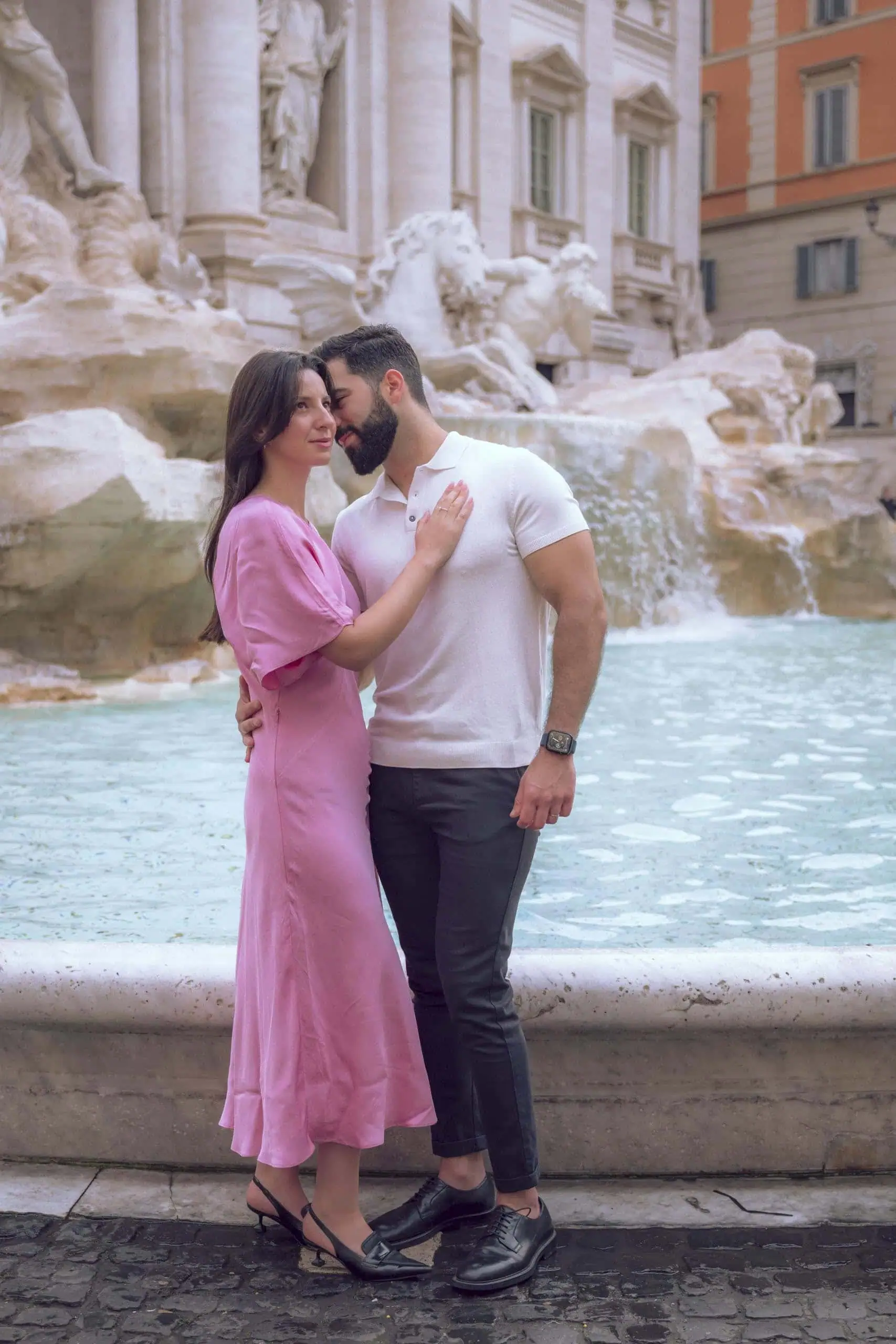
Larger monuments, Colosseum, Trevi Fountain, Vatican, work best when the session moves around and through them rather than planting in one spot for a series of held poses. I shoot at over 30 locations across Rome and choose the framing and angle based on crowd position and light direction at the exact moment. The difference between a stiff-looking photo at the Trevi Fountain and a natural one is almost always a question of whether you were mid-step or standing still.
TipVilla Borghese park is open from dawn to dusk every day with no entry fee for the gardens. Morning weekday visits have the fewest visitors and the best soft light.
Sunrise and the hour before sunset produce the softest, most even light across every location in Rome. Harsh midday sun creates strong shadows under the eyes and nose, which forces more deliberate posing to compensate. Early morning also means fewer crowds at major landmarks, which removes the stop-start rhythm that kills natural movement in a session. I also offer night sessions at the Colosseum and Trevi Fountain, where the artificial lighting is warm and consistent and the quieter streets allow a completely different, more intimate pace.
Season matters less than time of day for looking natural, but spring and autumn give the most cooperative conditions: mild temperatures mean you are not squinting into heat or hunching against cold, both of which register in posture. The Signature session, at two hours across two locations, is the most popular package precisely because the longer duration lets the early frames settle and the later frames relax. By the second hour, most people have forgotten the camera is there.
TipIf you book a morning session, plan your hair and outfit the night before. Starting on time is the single biggest factor in hitting the best light window.
Wear clothes you have already worn. New outfits introduce discomfort: unfamiliar fabric, an uncertain fit, self-consciousness about how something looks. If you are breaking in shoes for the session, stop. Sessions cover 3 to 5 kilometres on foot across Rome's cobblestone streets, and foot pain produces a visible tension that affects the entire session. Comfortable clothes you feel good in translate directly into relaxed body language.
Arrive five minutes early and spend that time walking around the meeting point rather than standing still. Movement before the session begins lowers the physical tension that shows up in the first frames. Bring any item that matters to you on the trip: a hat, a scarf, a book you have been reading in cafes. Props that belong to your actual trip look natural because they are natural.
TipA scarf, a hat, or a jacket you can take on and off gives the session natural variation without a wardrobe change.
Every session is shot and edited by Finzi personally. The Essential (1 hour, 30 photos, 1 location) works well for a focused session at a single landmark. The Signature (2 hours, 50 photos, 2 locations) is the most popular option and gives enough time for the initial stiffness of any session to pass entirely. The Prestige (3 hours, 60 photos, 3 locations) suits those who want a full walk across several parts of Rome. Proposals are covered by a dedicated session using a hidden camera approach. All images are delivered within 24 hours.
A €30 deposit secures the date. Rescheduling is free with no time limit attached. Pick a session. Choose a date. I handle the rest.
TipBook 2 to 4 weeks ahead during April to October. Last-minute bookings are sometimes possible. Contact Finzi directly to check availability.
Quick answers to the questions visitors ask before they book.
“Finzi made us feel so at ease from the first minute. We kept saying we were not good at photos but he just kept us moving and talking and the results were incredible. We cried when we saw them.”
Pick a session. Choose a date. I handle the rest.
BOOK NOW