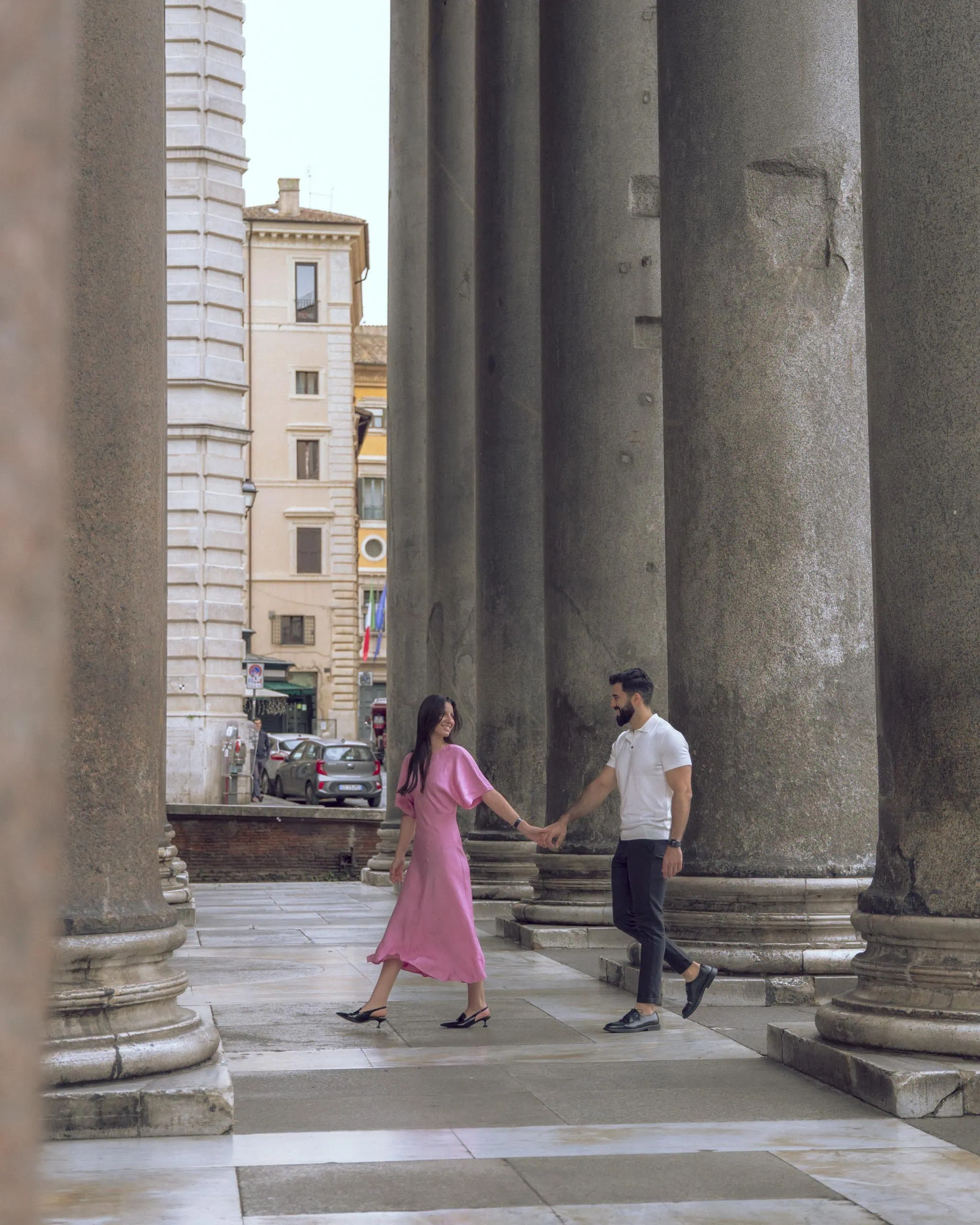
When to shoot, where the light lands, and how to plan by session type
The best time of day for photos in Rome is the hour after sunrise or the hour before sunset, when warm directional light flatters the stone architecture and crowds are thinnest. This guide covers every lighting window available in Rome, from pre-dawn blue hour to artificial night light, and tells you which window fits which location and session type. If you are booking a professional photo session or planning shots on your own, timing is the single biggest variable you can control.
Rome sits at latitude 41.9° North, which means golden hour windows shift significantly across the year. A summer evening golden hour can run nearly an hour after 8 PM. A December golden hour closes before 5 PM. Knowing the window for your specific travel dates changes everything.
Golden hour in Rome occurs twice daily: once just after sunrise and once just before sunset. According to the NOAA Solar Calculator, Rome's coordinates (41.9° N, 12.5° E) produce a sun path that shifts the direction of light markedly between seasons. In summer, the sun rises far to the northeast and sets to the northwest, meaning the Colosseum and east-facing monuments catch warm front light at dawn while west-facing locations like the Spanish Steps glow at dusk. In winter, the arc is lower and more southerly, producing softer, raking light for longer each day.
Blue hour, the period of indirect twilight immediately before morning golden hour and immediately after evening golden hour, gives the sky a deep, saturated tone. At this moment, artificial city lights and natural sky light balance almost perfectly, making it the ideal window for lit monuments like the Trevi Fountain and the Colosseum against a coloured sky. Midday light, roughly between 11 AM and 3 PM in any season, is harsh, high-contrast, and creates unflattering shadows on faces. It is the one window I actively avoid for portraits.
TipCheck the specific golden hour window for your travel dates at gml.noaa.gov/grad/solcalc, entering Rome's coordinates.
| Package | Price | Duration | Photos | Locations |
|---|---|---|---|---|
| Essential | €300 | 1 hour | 30 photos | 1 location |
| Signature | €500 | 2 hours | 50 photos | 2 locations |
| Prestige | €800 | 3 hours | 60 photos | 3 locations |
Rome's daylight range is wide. In late June, sunset pushes past 8:30 PM and golden hour runs close to 9 PM. In late December, golden hour closes before 5 PM and sunrise golden hour starts around 7:30 AM. Spring and autumn sit in the middle: April golden hour runs roughly 7 PM to 8 PM in the evening and 6 AM to 7 AM in the morning. October brings some of the most consistent, warm-toned light of the year, with golden hour arriving when the city is still manageable crowd-wise.
Summer is photogenically generous with its late golden hour, but the trade-off is heat and crowd density. Early morning becomes the primary option for locations like the Trevi Fountain and the Spanish Steps, where midday and afternoon crowds are at their peak. Autumn and spring offer the best balance of workable golden-hour timing, pleasant temperatures, and thinner crowds. Winter produces low, angular light all day, which is genuinely flattering for architecture and wide street scenes, even outside golden hour.
TipOctober is the most reliable month for warm evening light and manageable crowds across all major Rome locations.
Early morning is the only window that solves the crowd problem at Rome's most visited spots. The Trevi Fountain, normally packed from late morning onward, is nearly empty before 7 AM. The Spanish Steps, the Pantheon piazza, and Piazza Navona all thin out dramatically in the hour after sunrise. The light at this time is directional and warm, though at some east-facing monuments the sun can backlight the structure early on, so positioning matters.
I use morning sessions for locations where crowd management is as important as the light itself. If your priority is a clean shot at the Trevi Fountain with nobody standing behind you, morning is non-negotiable. The Colosseum is another strong morning location: the eastern facade catches the first direct light and the area in front of the Arch of Constantine sees far fewer people before the tour groups arrive.
TipFor the Trevi Fountain in summer, arriving at or before blue hour gives the widest clear space and the fountain lit against a pre-dawn sky.
Evening golden hour is the window most clients request and the one that delivers the warmest, most flattering portrait light. West-facing locations get the best of it. The Spanish Steps face roughly west, which means they catch direct low sun in the late afternoon and are ideal for golden-hour sessions. Trastevere's narrow cobblestone streets channel the last light between buildings, creating warm pockets. The Gianicolo hill offers a panoramic view over the city skyline at exactly the moment the rooftops turn amber.
Villa Borghese and its gardens provide elevated views and open space that catches evening light without the tight-crowd pressure of the centre. The Roman Forum columns cast long dramatic shadows in the last hour before sunset, which works well for wider environmental shots. The key discipline at golden hour is moving with the light, not staying fixed. As the sun drops, the angles shift every ten minutes.
Tip"The light changes every ten minutes at golden hour," Finzi says. "I plan two or three positions in advance so we move with it rather than chase it."
Night is not a consolation for missing golden hour. It is its own distinct window. The Colosseum is floodlit after dark, and the open piazza around it empties compared to peak daytime. The Trevi Fountain is illuminated at night and the surrounding narrow streets are quieter, making it one of the rare moments the scale of the fountain is visible without bodies blocking the basin. Blue hour, the 20-30 minute window immediately after sunset, is where night photography starts: the sky retains colour while the artificial lights of the city are already on.
I offer dedicated night sessions for exactly these conditions. The technical requirements are different from daylight work and the editing approach is distinct. If the Colosseum or the Trevi Fountain at night is the specific image you want, a night session is the right choice rather than hoping a daytime session finishes late enough.
TipNight sessions require different editing and are priced separately. Book this specifically if your priority is the Colosseum or Trevi Fountain after dark.
Midday light in Rome is high, direct, and short-shadowed. For portraits, it is the least forgiving window: harsh under-eye shadows, blown highlights on pale skin, and flat, uninspiring backgrounds. Between roughly 11 AM and 3 PM in summer, avoid planning portraits outdoors at open monuments. The one exception is shaded locations. Trastevere's narrow lanes and the covered porticos near the Pantheon remain workable at midday because direct overhead light never fully enters.
Midday is actually useful for architectural and detail photography where sharp contrast and saturated colour are desirable, but for the kind of session most visitors to Rome are booking, it is the weakest option. If a midday slot is the only time available, shaded street locations and interior courtyards are the practical answer.
TipIf your schedule only allows a midday slot, choose Trastevere's side streets. The canopy of buildings handles the light problem for you.
Not every location performs equally at every time of day. The Trevi Fountain works best at early morning (crowd-free, soft directional light) or at night (lit against dark sky). The Colosseum is strong at morning golden hour when the eastern facade is front-lit, and again at night when it is floodlit. The Spanish Steps face west and reward late afternoon and evening sessions. The Roman Forum suits morning and evening golden hour for its dramatic column shadows. Piazza Navona, open and symmetric, works morning and late afternoon when the ochre facades warm up.
Trastevere is flexible across the day due to its tight lane geometry, but late afternoon into evening golden hour brings the cobblestones and ivy-covered walls to their best. Villa Borghese gardens offer open grass and elevated views that work particularly well in the hour before sunset. The Gianicolo provides the city panorama and is positioned perfectly for a west-facing sunset backdrop. At Pincio, the terrace looks out over Piazza del Popolo and the city and catches the full warmth of the setting sun.
TipI cover 30+ locations across Rome. Tell me your priority locations when booking and I will map them to the right time slot.
When you book, you choose a session type, a date, and a preferred time. I then confirm based on availability and the light conditions for that specific date. The €30 deposit locks the date. If your travel plans shift, reschedules are free with no time limit.
For golden-hour sessions, I recommend booking at least 2-4 weeks ahead, especially from April through October when demand for the late-evening slot is highest. The Signature package at €500 covers two hours and two locations, which is the most practical format for covering both a morning crowd-free spot and a second location in a different light condition. The Prestige package at €800 extends to three hours and three locations, which allows a full arc from one lighting window into another.
TipTwo-location sessions are the most practical for pairing a crowd-free morning spot with a golden-hour second location later in the day.
Quick answers to the questions visitors ask before they book.
“Finzi was incredibly professional and made us feel so comfortable. The photos were delivered within 24 hours and they were absolutely beautiful. He knew exactly where to go and when for the best light.”
Pick a session. Choose a date. I handle the rest.
BOOK NOW