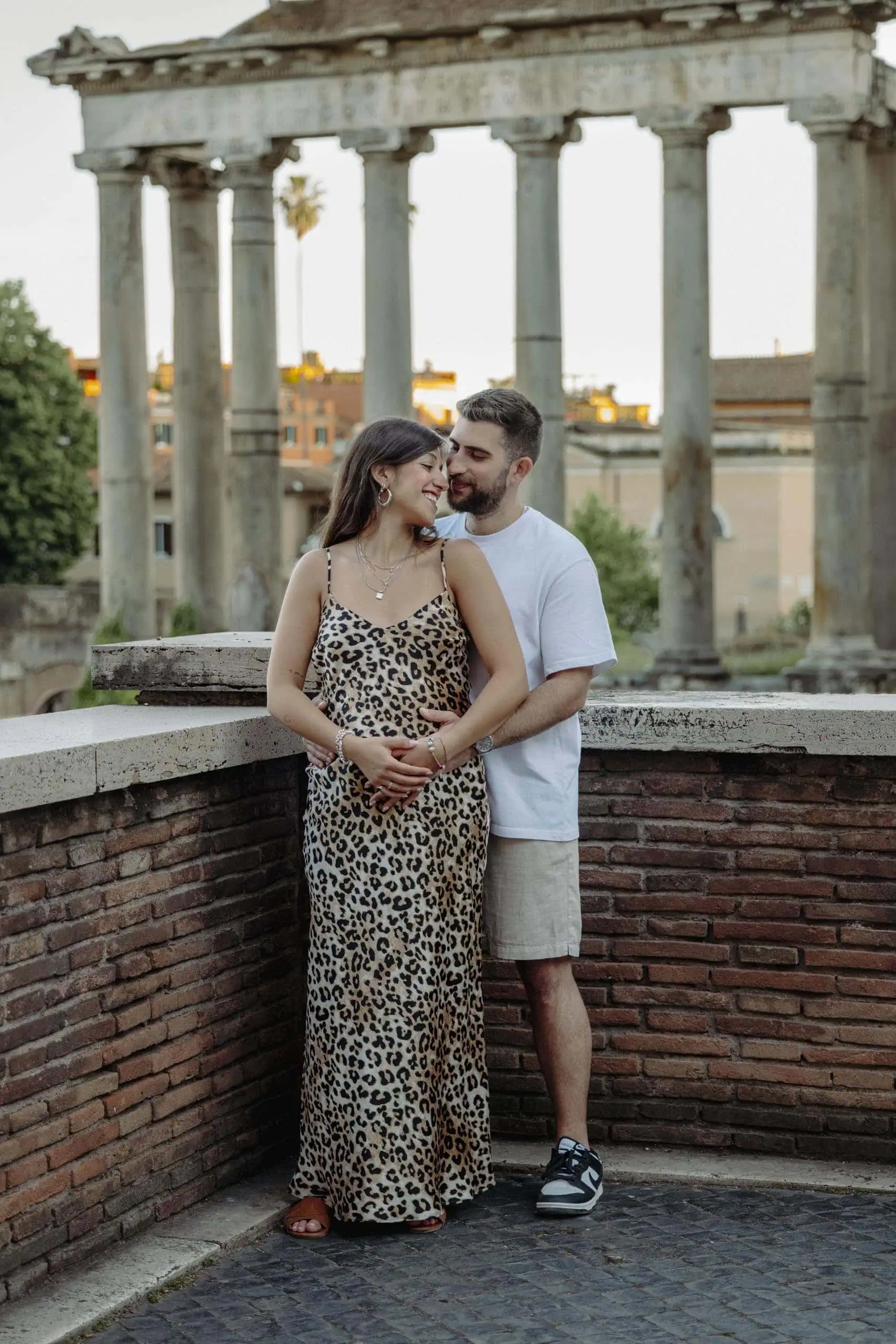
Light, crowds, locations, and logistics compared season by season
Sunset is the better default for most visitors, and sunrise is the better choice when you want empty monuments or are travelling in summer. Both windows give you warm, directional golden-hour light. The real difference comes down to three things: where you plan to shoot, what time of year you are visiting, and how early you are willing to set an alarm.
This guide breaks down the practical trade-offs so you can make the call before you book. It covers light quality, crowd conditions, seasonal timing, and which Rome locations suit each window. If you already know you want to book, every package starts from €300 and delivery is within 24 hours.
Golden hour in Rome occurs twice daily: once just after sunrise, once in the hour before sunset. According to timeanddate.com, Rome's latitude of 41.9° means the city sees significant seasonal swings in when those windows open and how long they last. In midsummer the evening golden hour can begin close to 19:30 and run to past 20:00 local time. In December the same window compresses and arrives in the mid-afternoon.
The quality of the light is nearly identical at both ends, but the direction differs by season. In summer, the sun rises northeast and sets northwest, so the exact angle it throws across your chosen monument changes completely depending on which end of the day you pick. At the equinoxes in March and September, the sun rises almost due east and sets almost due west, giving the most symmetrical light across most monuments. That symmetry is one reason spring and autumn shoots look so consistently good regardless of timing.
TipCheck the exact golden hour for your travel date at timeanddate.com/sun/italy/rome before you confirm which session to book.
| Package | Price | Duration | Photos | Locations |
|---|---|---|---|---|
| Essential | €300 | 1 hour | 30 photos | 1 location |
| Signature | €500 | 2 hours | 50 photos | 2 locations |
| Prestige | €800 | 3 hours | 60 photos | 3 locations |
Sunrise wins on crowds, with no exception. The Trevi Fountain is open 24 hours a day and draws an estimated 10,000 to 12,000 visitors every hour during peak periods. The only window when the piazza is genuinely thin is the early morning, before the city wakes up. The same pattern holds at the Spanish Steps, Piazza Navona, and the streets of Trastevere. At sunset, those same spots are often at their busiest, with evening strollers added to the tourist flow.
Sunset still wins on convenience. Most clients are not willing to set an alarm for 04:30 in July. A sunset session fits naturally into a Rome evening: explore the city during the day, meet me near your first location late afternoon, shoot through golden hour, and finish with a glass of wine. The crowd trade-off is real but manageable, because I know which sides, angles, and secondary positions at each location stay cleaner even when the main piazza is busy.
TipIf you choose sunset and the Trevi Fountain is your priority, I position you to the side or above the main pool, not in the central crush.
In summer (June to August), sunrise in Rome is early, before 06:30 local time. That is a real commitment, but it delivers the Colosseum exterior, the Roman Forum terrace, and the Trevi Fountain in near-empty conditions with low, warm light. Sunset in summer is after 20:00, which means golden hour runs late into the evening, fits dinner plans, and carries soft amber tones across the city's stone. Summer sunset sessions are long, comfortable, and logistically easy.
In winter (November to February), the calculation reverses. Sunrise arrives late enough to be manageable, and sunset falls in the mid-to-late afternoon, which aligns naturally with a sightseeing day. Spring and autumn are the most flexible, because both windows land at reasonable hours and the equinox light is especially even across most of Rome's open piazzas and ancient stone. April to October is peak season, so booking 2 to 4 weeks in advance is advised.
TipOctober and April offer some of the most consistent light conditions of the year, and crowd pressure is lower than July or August.
Sunrise works best at locations where crowds are the core problem. The Trevi Fountain, Spanish Steps, and Piazza Navona all become genuinely accessible in the early morning. The Colosseum exterior catches the rising sun on its eastern face in spring and summer, which gives strong modelling across the arches. Trastevere's narrow streets are quiet and lit softly from above at dawn, without the afternoon foot traffic.
Sunset works best at elevated viewpoints and west-facing terraces. The Gianicolo hill looks directly toward St. Peter's as the sun drops behind it. Pincio overlook faces west across the whole city and catches the last hour of light across rooftops and domes. Villa Borghese's open lawns hold the golden hour evenly in any direction. These spots are best with the sun in front of you, which means late in the day is structurally correct.
TipA Signature or Prestige session covers two or three locations, so you can combine an elevated viewpoint at sunset with a fountain or piazza as a second stop.
"My default recommendation is sunset," Finzi says, "because most people visiting Rome are not going to wake at 04:30. But if someone tells me the Trevi Fountain is the one shot they cannot leave without, I tell them: sunrise is not optional, it is the only answer." The crowd issue at Trevi at any other hour is simply not solvable by positioning alone, no matter how many secondary angles I know.
The exception runs the other way too. Clients who want the Gianicolo, Pincio, or the Villa Borghese lawns will almost always get a better photograph at sunset. Those locations face west or are open enough that the directional late-day light wraps around the subject in a way that morning light cannot replicate from those same positions. The right answer is always location-first, then time.
TipTell me your one non-negotiable location when you book. I plan the session time and sequence around it.
Yes, in practical terms. A sunrise session means meeting before the city is running: transport is quieter, streets are empty, and the light window is clear. The trade-off is an early start, and in summer that means a very early start. Sessions run 1 to 3 hours depending on the package, and at that hour the city is yours. An Essential session of 1 hour at sunrise at a single location is often enough to get everything you came for, because the conditions do the work.
A sunset session lands when Rome is alive. Streets are busy, cafés are full, and the energy is high. That energy sometimes shows in photographs in a good way: real city life in the background, movement, warmth. The golden hour window closes at dusk, and I also offer dedicated night sessions, so if you want the Colosseum or Trevi Fountain lit against a dark sky, that is a separate session designed specifically for that. Sessions never run over time without your agreement, and reschedules are free with no deadline.
TipWalking per session is 3 to 5 km. Wear comfortable shoes regardless of which time you choose.
Answer two questions. First: is there one specific monument where crowd-free is non-negotiable? If yes, choose sunrise. If no, continue. Second: are you visiting in summer (June to August)? If yes, sunset is more practical and still gives you full golden-hour light. If you are visiting in winter, either window is manageable, but sunset aligns with a normal day.
If you are still undecided, choose the Signature package, which covers two locations and two hours. That gives enough time to start at one location as the sun is still descending and move to a second as it drops. You get variety in the light across the session rather than a single fixed moment. Pick a session, choose a date, and I handle the rest.
Quick answers to the questions visitors ask before they book.
“Finzi was incredibly professional and made us feel completely at ease. The photos were delivered within 24 hours and were beyond anything we expected. Worth every cent.”
Pick a session. Choose a date. I handle the rest.
BOOK NOW