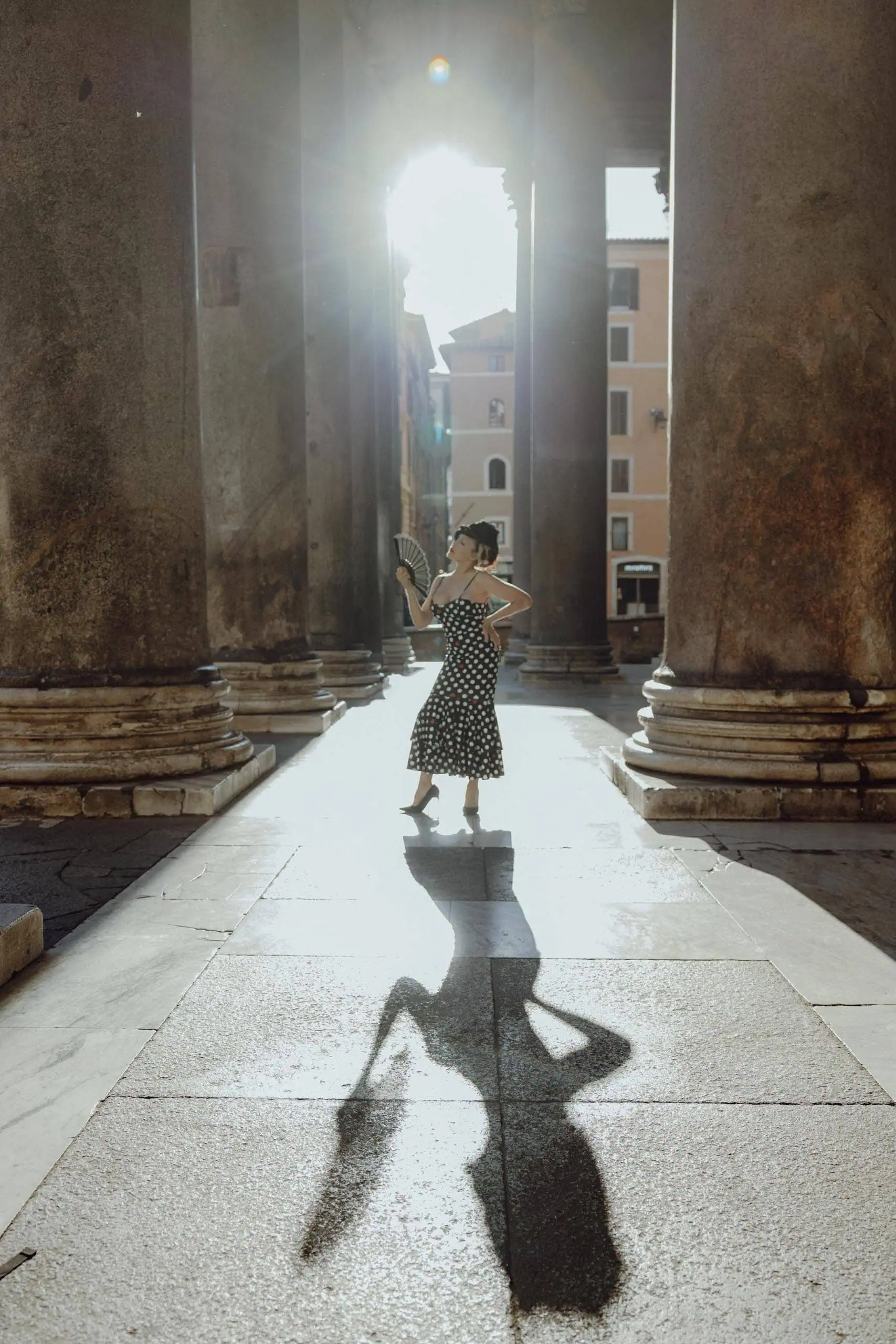
When to shoot, where to go, and how to stay comfortable in July and August
Summer is one of the most rewarding seasons to photograph in Rome, and one of the most demanding. July and August bring long days, near-cloudless skies, and golden light that lasts well past 8 pm, but they also bring temperatures that regularly hit 35-38 °C and crowds that pack every major site from mid-morning onward. This guide covers timing, location strategy, session logistics, and what to expect from a photoshoot booked during Rome's hottest months.
If you are visiting Rome in June, July, or August and want professional photos, the session is absolutely doable. The key is understanding how summer light and summer crowds work together, and planning your session around both. Everything below is based on real summer conditions in Rome and on how I have structured sessions here for years.
Rome in July and August is hot, dry, and intensely sunny. According to Weather Atlas, July is Rome's hottest month, with average daytime highs of 30.3 °C (86.5 °F) and an average of 10.7 hours of direct sunshine per day. Spikes during heatwaves push readings to 38-40 °C, and the city's cobblestones, marble, and stone facades absorb heat and radiate it back well after sunset. Weather Atlas describes July as "characteristic of its notoriously hot and dry sensation."
For photography, the intense sun is a double-edged factor. From around 10 am to 5 pm, overhead light is flat, harsh, and creates deep unflattering shadows on faces. Before that window and after it, the light drops to a warm angle that is exactly what professional portraits need. Sunset in early July falls around 8:49 pm local time, giving you an extended golden hour that is genuinely one of Rome's best photographic assets. That long evening window is why summer sessions here can be exceptional, not despite the heat but because of the schedule it forces.
TipTip: The city's stone surfaces make it feel several degrees hotter than the official temperature. Wear breathable fabric and carry water for the walk between locations.
| Package | Price | Duration | Photos | Locations |
|---|---|---|---|---|
| Essential | €300 | 1 hour | 30 photos | 1 location |
| Signature | €500 | 2 hours | 50 photos | 2 locations |
| Prestige | €800 | 3 hours | 60 photos | 3 locations |
The Colosseum, Trevi Fountain, Pantheon, Vatican, Piazza Navona, and Spanish Steps are heavily crowded from late morning through mid-afternoon every day in July and August. Early morning is the clearest window: at 7 am Rome's main sites are still relatively empty, and by 8-8:30 am the first tour groups begin arriving. Late afternoon, from roughly 5 pm onward, is the second clear window, when crowds begin to thin and the light starts to warm. Midday is the worst combination of heat and crowd and is best avoided for any outdoor photoshoot.
Some locations hold up better than others in summer. Trastevere and Pincio are less visited than the central landmarks and stay manageable even later in the morning. Villa Borghese offers shade from its tree canopy, which both cuts the heat and softens the light at almost any hour. The Colosseum's side staircases and lower tiers see far fewer people than the main viewing platform. The Trevi Fountain, lit brilliantly after dark, is one of the strongest locations for a summer night session precisely because the crowd composition shifts and the temperature drops to a workable 25-28 °C.
TipTip: I schedule summer sessions to start at sunrise or in the last two hours before sunset. Both windows give cleaner backgrounds and far better light than anything in the middle of the day.
I structure every summer session around the light and the crowds, not around a fixed clock. For sunrise sessions, we meet at the first location just as the sky begins to lighten. The city is quiet, the pavements are cool, and the golden-pink light lasts about 45 minutes before it climbs too high. For golden hour and sunset sessions, I time the start so that the most important shooting happens in the last 90 minutes of daylight, when the warm directional light is consistent and the temperature has begun to drop. I also offer dedicated night sessions at the Colosseum and Trevi Fountain, specifically designed for summer visitors who want to photograph those sites without the midday crowd or heat.
"In summer I plan the walk between locations during the hottest part of the afternoon so my clients are moving through shade and resting, not shooting," Finzi says. "We do the serious work at the edges of the day." A standard summer session covers 3 to 5 km of walking total. I choose routed paths that move through narrower, shadier streets where possible. You do not need to arrive in athletic shape, but comfortable walking shoes and a water bottle are practical requirements for any summer session.
TipTip: Book a night session (€450) if daytime heat is a concern. The cooler temperature and the lit fountains make for a completely different set of images.
Natural fabrics, particularly linen and lightweight cotton, photograph well in summer and handle the heat better than synthetics. Solid colours hold up best in strong direct light. Light neutrals (cream, sand, warm white, stone) photograph cleanly and do not absorb heat the way dark colours do. If you are photographing as a couple or with a partner, align your palette rather than matching exactly: complementary tones look intentional without looking like a uniform. Avoid busy prints in direct summer light, which can create visual noise in otherwise clean frames.
Comfort is not a secondary concern. If you are overheating, it shows in posture and expression. Layers you can remove between locations give flexibility: a linen shirt over a simple vest, a light scarf that can come on or off. Shoes matter more in summer than in other seasons because the cobblestones get genuinely hot. Sandals with grip work. Heels over a short block are fine for portions of the session on smooth surfaces but impractical across the Forum or the longer Trastevere routes. Plan footwear for the walk, not just the frame.
TipTip: Bring a small fan or cooling mist spray in your bag. Between shooting positions you have time to use it, and it makes a real difference across a two- or three-hour session.
Not all of Rome's 30-plus shootable locations behave the same way in summer. The Colosseum exterior is extraordinary at sunrise when the low light rakes across the stone and the piazza is nearly empty. By mid-morning it is one of the most crowded spaces in the city. The Trevi Fountain is the opposite case for summer: it photographs better at night, when the artificial illumination is warm and consistent and the surrounding heat has dropped. Piazza Navona holds up reasonably well in the early morning and again in the evening, its open space catching any breeze that moves through the centro storico.
For shade and atmosphere combined, Trastevere's narrow streets are consistently one of the strongest summer locations. The buildings create natural shade corridors even at mid-morning, the light that bounces between the ochre and terracotta walls is warm and diffused, and it is far less crowded than the central landmarks. Villa Borghese works well on the same logic: the tree canopy creates dappled shade across gravel paths, and the views south over the city from the Pincio terrace give wide background options that no other location in Rome matches at golden hour. For a multi-location Signature or Prestige session, combining an early-morning landmark (Colosseum or Trevi area) with a mid-session Trastevere walk and a golden hour finish at Pincio is a reliable summer structure.
TipTip: The Gianicolo terrace gives one of the widest views over Rome's rooftops and catches the last direct light of the evening. It is underused in summer and almost always manageable for crowd levels.
For couples, partners, or solo travellers who want one strong location at the ideal time of day, the Essential session (€300, one hour, 30 photos, one location) is a focused and efficient choice. It is well suited to a single sunrise slot at the Colosseum or a dedicated golden hour position at Pincio or Trastevere. For those who want to cover more of Rome or combine a landmark with a neighbourhood, the Signature session (€500, two hours, 50 photos, two locations) is the most popular choice and gives enough time to do both an early location and a second one as the light develops. The Prestige session (€800, three hours, 60 photos, three locations) is the right fit when you want to build a proper story across the city: a sunrise landmark, a shaded mid-session neighbourhood walk, and a golden hour or night finish.
Summer is peak season. I recommend booking at least two to four weeks in advance, and earlier if you have specific dates. A €30 deposit locks your date. Rescheduling is free and available any time, with no deadline attached. If a heavy storm makes shooting impractical, I offer a free postponement within 48 hours. All edited images are delivered within 24 hours of the session. Proposal sessions (€300, one hour, hidden camera) also work well in summer; the evening timing and the lit piazzas are particularly good for that format.
TipTip: Summer is one of the busiest booking periods. Contact me directly to check last-minute availability, but securing your date 2-4 weeks ahead gives the most flexibility on timing.
Quick answers to the questions visitors ask before they book.
“Finzi was incredible from start to finish. He knew exactly when and where to place us for the best light and the photos came back the next day looking like they were shot for a magazine.”
Pick a session. Choose a date. I handle the rest.
BOOK NOW