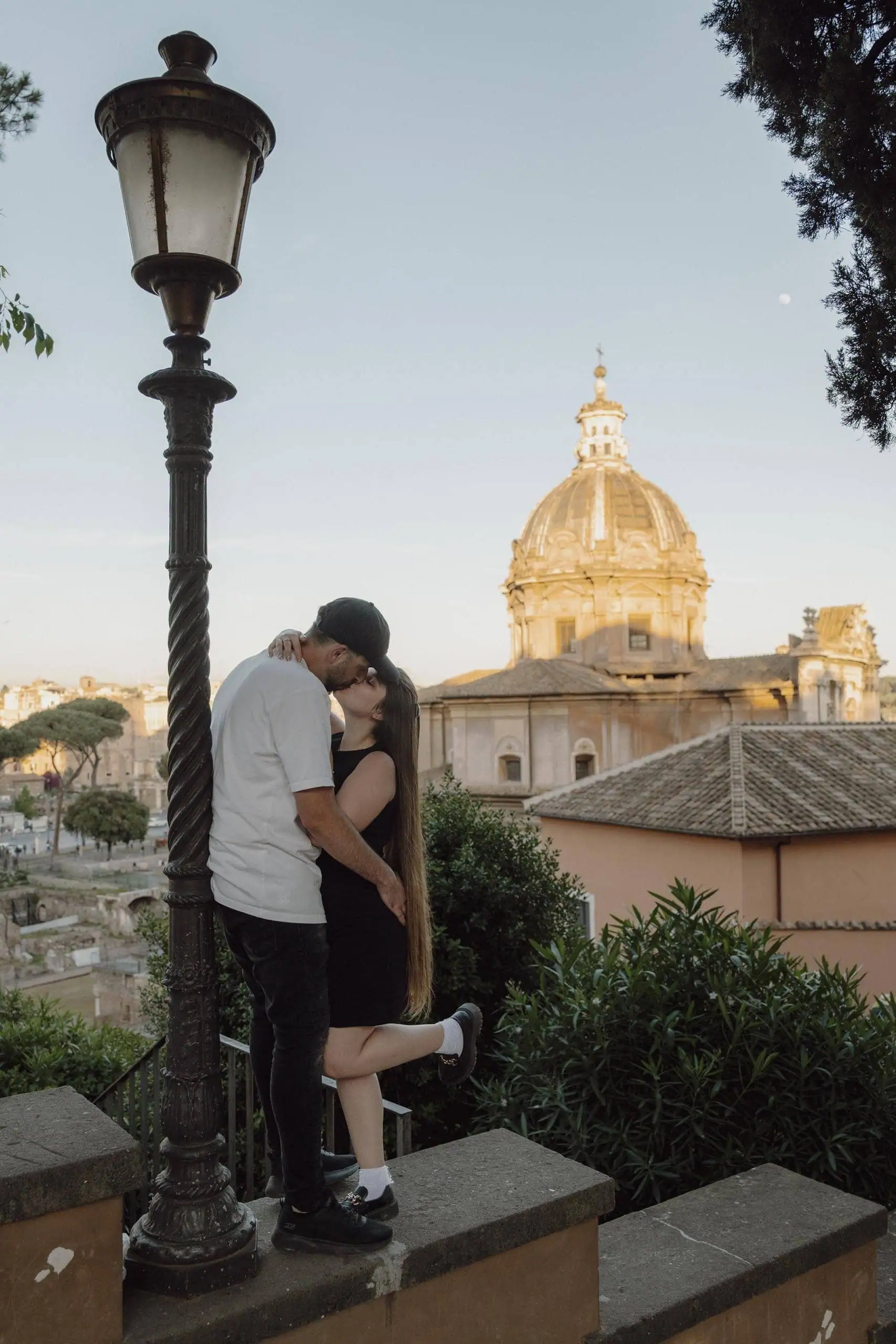
How to plan a couple or engagement session at Rome's Baroque centrepiece
Piazza Navona is one of Rome's most atmospheric spots for a couples or engagement photoshoot, with the Fountain of the Four Rivers offering the most striking backdrop at any time of day. This guide covers everything you need to plan a couple or engagement photoshoot at Piazza Navona: the best times to arrive, which of the three fountains work best for portraits, how crowds move through the day, and which Finzi package fits a session here.
Piazza Navona is a pedestrian-only square in Rome's historic centre, open around the clock with no entry fee. It holds three Baroque fountains, a church facade by Borromini, and a 270-metre-long oval inherited from a 1st-century Roman stadium. For photography, that scale and those layers of stone, water, and sky give you a lot to work with.
Piazza Navona was built on the site of the Stadium of Domitian, constructed in 86 AD. Its elongated oval shape still mirrors that ancient layout, making it unique among Rome's major squares. The name itself derives from the Greek word 'agone,' meaning contest, the athletic games once held here, which over centuries shifted from 'agone' to 'navone' to 'navona.'
The Baroque transformation came in the 17th century under Pope Innocent X, who commissioned Gian Lorenzo Bernini to design the centrepiece Fountain of the Four Rivers in 1651 and tasked Francesco Borromini with the church of Sant'Agnese in Agone. The square holds three fountains in total: the Fontana dei Quattro Fiumi at the centre, the Fontana del Moro at the south end, and the Fontana di Nettuno at the north end. Rome's official tourism body,Turismo Roma, describes the Fontana dei Quattro Fiumi as the one Bernini received on the occasion of the Jubilee of 1650, and notes it sits around a tall Egyptian obelisk, one of several stone testimonies from the ancient Iseo Campense at Campo Marzio. For a photoshoot, that historical density translates directly into backdrop options: Baroque sculpture, layered architecture, and an open sky above an oval that no other location in Rome replicates.
TipThe square's pedestrian-only status means no parked scooters or cars to edit out of frames.
| Package | Price | Duration | Photos | Locations |
|---|---|---|---|---|
| Essential | €300 | 1 hour | 30 photos | 1 location |
| Signature | €500 | 2 hours | 50 photos | 2 locations |
| Prestige | €800 | 3 hours | 60 photos | 3 locations |
Piazza Navona is one of the most visited squares in Rome and crowds build fast once the day gets going. Early morning, roughly the first two to three hours after sunrise, is consistently the quietest window. The square has open sight lines, so you see the crowd density across the entire oval from any position. By mid-morning, tour groups and day visitors fill the central axis around the Fontana dei Quattro Fiumi, making clean portrait backgrounds harder to achieve.
The other productive window is the hour before and just after sunset. The light drops behind the buildings to the west of the square, creating a softer, more directional glow across the fountain sculptures and the Borromini facade. After sunset the fountains are lit, giving an entirely different mood, cooler blue tones and warm sodium accents on the stone. Spring and autumn, roughly mid-March to May and mid-September to November, combine the best light quality with the thinnest daytime crowds. Summer brings longer golden hours but heavier foot traffic. Winter is the quietest overall and the Christmas market, which runs through early January and centres on the Befana Festival, adds seasonal colour if that fits what you are after.
TipThe south end of the square, near the Fontana del Moro, clears faster than the central fountain area. Start there if you arrive and find crowds already forming.
Each of the three fountains gives a different photographic result. The Fontana dei Quattro Fiumi at the centre is the largest and most dramatic. Its four river-god figures face outward in different directions, which means you can position your subject against the base with the obelisk rising behind them, or step back and use the full sculpture as a frame within the wider oval. The Fontana del Moro at the south end is more compact and circular, with a single central figure, which makes it easier to isolate a couple in close proximity to the water without a cluttered background. The Fontana di Nettuno at the north end sits against the curved wall of the piazza and is often the least photographed of the three, giving the cleanest backdrop of the three.
Beyond the fountains, the facade of Sant'Agnese in Agone provides a strong vertical element directly behind the central fountain. The narrow streets that feed into the square, particularly Via dei Coronari to the north-west, offer a more intimate, corridor-like setting if you want a change of pace from the open square. The nearby Ponte Sant'Angelo is roughly a ten-minute walk and adds the Tiber and the profile of Castel Sant'Angelo for a second location within easy reach.
TipRain after a clear spell leaves water on the stone pavement, which reflects the fountain lights and adds depth to evening frames.
"I start at whichever fountain has the fewest people at that moment, not always the one you expect," Finzi says. "The Moro at the south end clears first most mornings. We get the water, the stone, and open sky behind the subject without battling a group of forty tourists on the other side of the lens. Then we move to the Quattro Fiumi once the light has shifted and the centre opens up a little."
I work alone at every session, which means there is no assistant directing traffic or drawing attention. Piazza Navona rewards a quiet, unhurried approach. I do not block off areas or use reflectors that flag our presence to passersby. The goal is to let the square and its architecture do the work, and keep the focus on you and your partner. Sessions here typically connect well with a second location, the Pantheon is about five minutes on foot to the east, or Campo de' Fiori a few minutes to the south, depending on which direction the session energy pulls.
TipWear a layer you can remove. The square is exposed and temperatures shift more than you expect between early morning and mid-session.
A single-location hour fits Piazza Navona well on its own. The Essential session, one hour, one location, 30 edited photos, covers the square in full without rushing. If you want to pair it with the Pantheon, Ponte Sant'Angelo, or another nearby spot, the Signature session, two hours, two locations, 50 edited photos, is the most practical choice and is also the most popular option I offer.
For couples or partners who want more range across the historic centre, the Prestige session covers three hours and three locations with 60 edited photos. All sessions are delivered within 24 hours. A €30 deposit locks your date, and rescheduling is free with no time limit attached. I recommend booking two to four weeks ahead, especially between April and October when demand is highest. Last-minute slots do come available, so it is always worth contacting me directly to check.
TipIf you are considering a proposal at the Fontana dei Quattro Fiumi, the Proposal session uses a hidden camera setup so the moment is captured without staging. It runs one hour at €300.
Piazza Navona is reached on foot from most of central Rome. The Pantheon is about a five-minute walk to the east, and Campo de' Fiori is a short walk to the south. The square itself is fully pedestrian, so there is no vehicle access to plan around. The cobblestones across the piazza and the surrounding streets are uneven in places, so flat or block-heeled footwear is practical if you are wearing anything formal. Sessions here cover the length of the square and may extend to a nearby street or square, so expect to walk.
For clothing, neutral and muted tones photograph well against the warm travertine stone and the green-grey of the fountain sculptures. Very bright or saturated colours can pull focus from the architectural backdrop. Early morning sessions in cooler months benefit from layering, as the square is wide open and loses warmth quickly. If you and your partner are wearing similar tones rather than matching outfits, the photos tend to look more natural within the Baroque setting.
TipAvoid matching outfits that are identical in colour. Coordinated but distinct reads better in editing and gives each person their own presence in the frame.
Piazza Navona is an open square with no shelter, which means direct sun in summer creates harsh contrast on faces and bleaches the stone. Overcast days actually work well for this location: the cloud diffuses the light evenly across the fountain sculptures and the facade of Sant'Agnese, which are deeply carved surfaces that benefit from softer illumination rather than direct sun at midday. Light rain after a storm leaves the pavement wet, and those reflections pick up the lit fountains in a way that is genuinely useful for evening frames.
I work in most weather conditions. Heavy storms trigger a free postponement, and that rescheduling carries no time limit. Spring and autumn give the most consistently useful light, but a grey January morning at Piazza Navona with almost no tourists in frame is not a bad outcome.
TipIf the forecast shows broken cloud for your session, that is often better than full sun. Diffused light over the Baroque stone is flattering and reduces post-editing time.
Quick answers to the questions visitors ask before they book.
“Finzi captured us perfectly at Piazza Navona. He knew exactly where to position us and when to move. The photos arrived the next morning and we were speechless.”
Pick a session. Choose a date. I handle the rest.
BOOK NOW