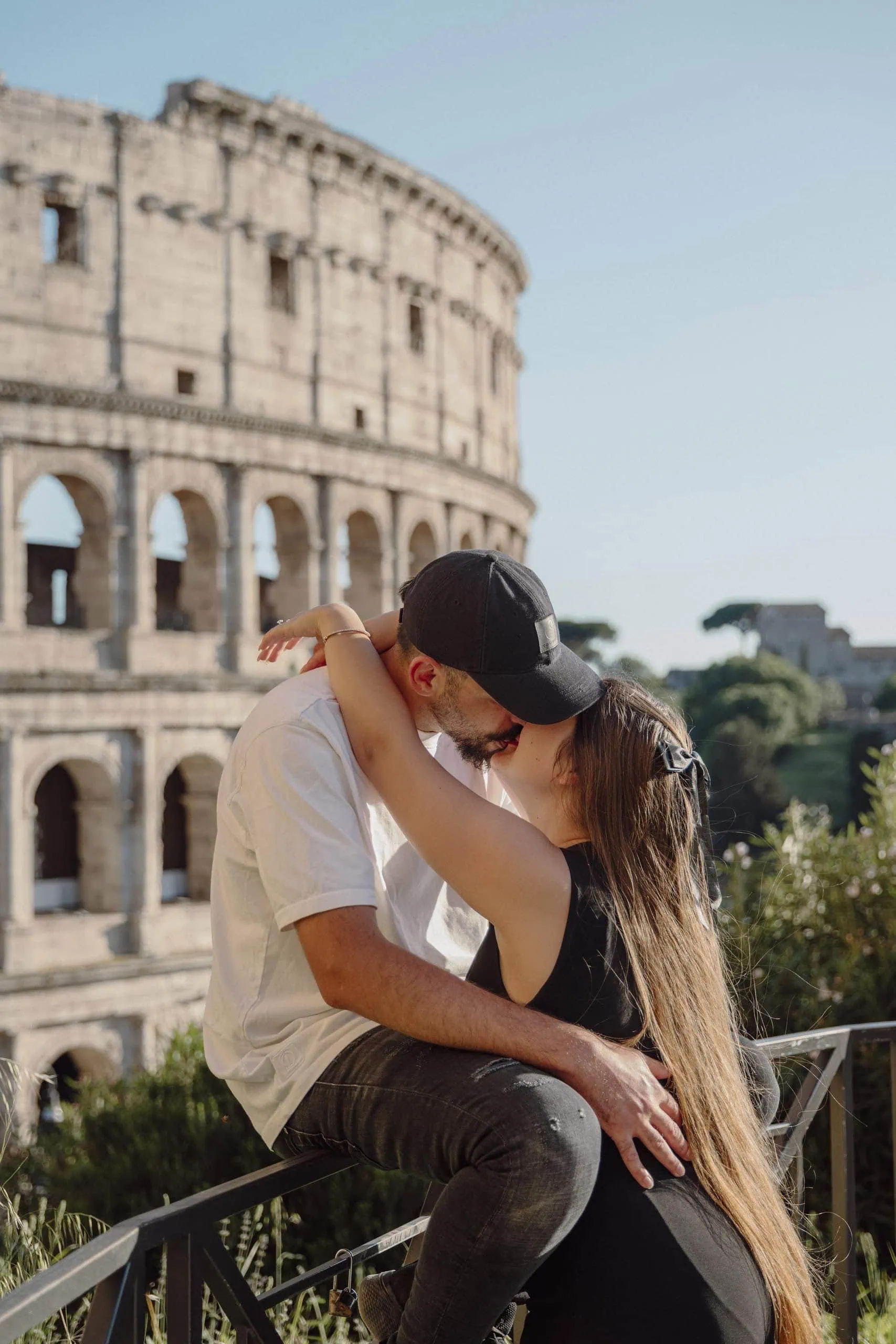
How to plan a couples session on Rome's most cinematic hilltop
Gianicolo (Janiculum Hill) offers one of the widest panoramic views of Rome's historic centre, making it one of the city's most rewarding settings for a romantic couple photoshoot. This guide covers everything you need to plan a romantic photoshoot at Gianicolo (Janiculum Hill): the best spots, when to arrive, how to get there, and which session to book with me. It is written for couples visiting Rome who want real, usable photos from one of the city's most sweeping viewpoints.
Gianicolo sits above Trastevere on the right bank of the Tiber, technically outside the ancient city but widely considered Rome's finest vantage point. From the main terrace you can see the Pantheon, Castel Sant'Angelo, St. Peter's Basilica, the Altare della Patria, and the Colosseum in a single unbroken arc. That panorama is your backdrop. My job is to photograph the two of you against it, without the chaos that typically comes with Rome's other famous spots.
Gianicolo has three distinct zones worth knowing before we arrive. The Terrazza del Gianicolo (Piazzale Garibaldi) is the main panoramic terrace, anchored by the equestrian statue of Giuseppe Garibaldi. From here the view stretches east across the entire historic center. The Fontana dell'Acqua Paola, known to Romans as il Fontanone, sits slightly lower on Via Garibaldi: a monumental Baroque fountain built between 1610 and 1614 under Pope Paul V, with five archways, cascading water, and a wide marble basin that fills the foreground of virtually every frame. Below and to the east, the tree-lined Passeggiata del Gianicolo runs between plane trees with more intimate framing options and far fewer visitors. According to Turismo Roma, the Fontanone was "designed and built to mark the terminus of the Trajan Aqueduct, between 1610 and 1614" and "comprises five archways flanked by columns."
Each zone photographs differently. The main terrace gives wide, city-behind-you portraits with the full Rome skyline as context. The Fontanone gives architectural depth and moving water. The Passeggiata gives shade, dappled light, and quiet. A two-hour Signature session or a three-hour Prestige session lets us rotate through more than one of these areas within a single booking.
TipThe Fontanone is illuminated at night and reflects light onto the surrounding stone, which changes the photographic character of the location completely after dark.
| Package | Price | Duration | Photos | Locations |
|---|---|---|---|---|
| Essential | €300 | 1 hour | 30 photos | 1 location |
| Signature | €500 | 2 hours | 50 photos | 2 locations |
| Prestige | €800 | 3 hours | 60 photos | 3 locations |
Gianicolo faces east over the city center. That orientation is the key fact for timing your session. The late afternoon sun falls behind you as you look out, which means the rooftops and domes in front of you catch direct warm light during golden hour. The contrast between the lit skyline and the deepening sky behind it sharpens by the minute during that window. Practically speaking, the hour before sunset is when this location is at its photographic best.
Sunrise is the opposite scenario: the sun rises over the city, which means it is mostly backlit during early morning. That can work well for atmospheric, high-contrast portraits, but the standard light advantage sits firmly in the late afternoon. Weekday mornings are significantly quieter and still produce good diffused light, which is worth considering if your travel schedule rules out a late session. I offer sessions at both sunrise and golden hour, and I will advise which fits your available dates once you contact me.
TipIf crowds build at the main terrace during golden hour, I move us to the side paths or the Passeggiata, where the light is identical but the foot traffic drops immediately.
Gianicolo is not Trevi Fountain or the Colosseum, but it is not empty either. There is no metro stop nearby, which filters out a significant share of casual foot traffic. The people who make it up here are mostly Romans out for a passeggiata and visitors who planned ahead. That said, the main terrace fills noticeably around the sunset window, especially on weekends between April and October. The noon cannon tradition, which has fired every day since 1847, draws a brief mid-day cluster as well.
The workable strategy is simple: the Fontanone and the side paths of the Passeggiata thin out quickly once you step away from Piazzale Garibaldi. I know which angles keep other visitors out of frame and which spots on the promenade give unobstructed city views. Weekday late afternoons consistently offer the best balance of light quality and manageable crowd levels. If sunset on a weekend is the only time your trip allows, we work with it. I have shot this hill in every condition.
TipGo down one level from the main terrace or onto the side staircases and the crowds thin dramatically. This is where I position us when the piazza is busy.
The most direct approach on foot is from Trastevere. From Piazza di Santa Maria in Trastevere, take Via della Paglia behind the church, then turn onto Via Garibaldi and follow it uphill. The climb is steep and takes roughly 20 to 25 minutes on foot. You arrive at the Fontanone first, then continue up to the main terrace. Comfortable, flat-soled shoes matter here. Cobblestones and uneven paths are unavoidable.
If the uphill walk is not workable, buses serve the hill from Trastevere and from the Vatican side. A taxi to Piazzale Garibaldi drops you directly at the main terrace. Gianicolo is also about a 20-minute walk from Vatican City and 30 minutes from Piazza Navona. For our session, I handle the full logistics briefing once you book: exact meeting point, parking notes if relevant, and the planned route between shooting spots.
TipWear shoes you have already broken in. The walk between shooting spots includes uneven stone paths, and new footwear creates problems halfway through.
The dominant tones at Gianicolo are warm ochre stone, green pine trees, and a pale blue or golden sky depending on the hour. Solid colours in earthy, muted ranges, warm neutrals, deep greens, or classic navy read well against all three. Bright white works at golden hour when the light is warm enough to prevent overexposure. Avoid busy prints and high-contrast logos, which compete with the architectural background rather than complementing it.
Layering is practical here because the hill catches wind even on warm days, and the walk up will raise your temperature before the session begins. Plan for a quick change if needed. Bring something to carry any outerwear once you've warmed up. I will send you a short outfit brief with specific colour suggestions once your session is confirmed.
TipIf you plan to wear something formal, carry it in a bag and change on arrival rather than walking uphill in it.
The Essential session (€300, 1 hour, 30 photos, 1 location) works if you have a tight schedule and want to focus on one zone, either the main terrace or the Fontanone. It is direct and efficient. The Signature session (€500, 2 hours, 50 photos, 2 locations) is the most popular choice for Gianicolo because it gives enough time to work the Fontanone, the main terrace, and the Passeggiata promenade, and still pair the hill with a second location such as Trastevere below. The Prestige session (€800, 3 hours, 60 photos, 3 locations) lets you build a full Rome day: Gianicolo at golden hour followed by two more locations before or after.
I edit every image myself and deliver within 24 hours of the session. A €30 deposit locks your date. Rescheduling is free, with no time limit attached. I recommend booking 2 to 4 weeks ahead, particularly between April and October when dates fill quickly. Last-minute availability does sometimes open up, so contact me directly to check.
TipThe Signature session paired with Trastevere as the second location makes logistical sense: Trastevere is directly downhill from Gianicolo and the two areas complement each other in tone and character.
Spring (March to May) gives mild temperatures, longer days, and green foliage along the Passeggiata. Crowds begin building after Easter and peak by May. Autumn (September to October) is the other strong window: the light goes warm and amber earlier in the afternoon, temperatures drop to comfortable walking conditions, and the hill is less packed than mid-summer. October in particular gives very consistent golden-hour quality.
Summer (June to August) means long days and late sunsets, which can actually be useful for evening sessions. The heat mid-day is significant, so morning or late afternoon sessions are the practical choice. Winter (November to February) brings the fewest visitors and a distinctly different quality of light: cooler, cleaner, and often dramatic with cloud formations behind the city skyline. All four seasons produce distinct results at Gianicolo. I work here year-round.
TipOctober sits in a useful gap: tourist numbers drop after mid-month but the golden hour light is still warm and arrives early enough for a comfortable evening session.
Quick answers to the questions visitors ask before they book.
“Finzi was absolutely amazing. He made us feel so comfortable and natural, and the photos were delivered the next day, all striking. Highly recommend for anyone visiting Rome.”
Pick a session. Choose a date. I handle the rest.
BOOK NOW