What to do with your body before the shutter clicks
Relaxed hands and a natural posture are the two physical things that most determine whether a Rome portrait looks genuine or stiff. This guide covers what to do with your arms, hands, shoulders, and weight shift during a session with me, why these adjustments work, and how I guide you through them in real time at locations across Rome.
Most people arrive not knowing what to do with their hands. That is normal, and it is my job to fix it quickly. The tips below apply to solo travellers, couples, and families. They work at the Colosseum steps, the Trevi Fountain terrace, the alleys of Trastevere, and every other spot I use. You do not need to memorise them. Read them once, arrive, and I take it from there.
Tension travels straight to the hands. The moment someone stands in front of a camera, the natural response is to grip, clench, or flatten the fingers, and all three read as anxiety in the final image. The Professional Photographers of America notes at ppa.com that portrait photographers must pay close attention to body language because "people tend to judge an online photo more harshly than an in-person first impression." A stiff hand carries that judgment.
The other common problem is placement. Hands dropped flat against the thighs, crossed low in front of the body, or jammed into pockets without any bend in the arm all create a closed-off silhouette that flattens the whole frame. Neither problem is hard to solve once you know what to look for.
TipShake your hands loose at your sides for three seconds before each shot. It works every time.
| Package | Price | Duration | Photos | Locations |
|---|---|---|---|---|
| Essential | €300 | 1 hour | 30 photos | 1 location |
| Signature | €500 | 2 hours | 50 photos | 2 locations |
| Prestige | €800 | 3 hours | 60 photos | 3 locations |
The simplest rule: hands should be at a slight angle away from the camera rather than flat toward it. A hand photographed square-on appears significantly larger and draws the eye away from the face. A hand turned to a three-quarter angle looks proportional and natural. This applies whether your hands are at your sides, resting on a surface, or touching your face. Keep fingers slightly curved, not straight out and not clenched. A gentle wrist bend adds shape without looking forced.
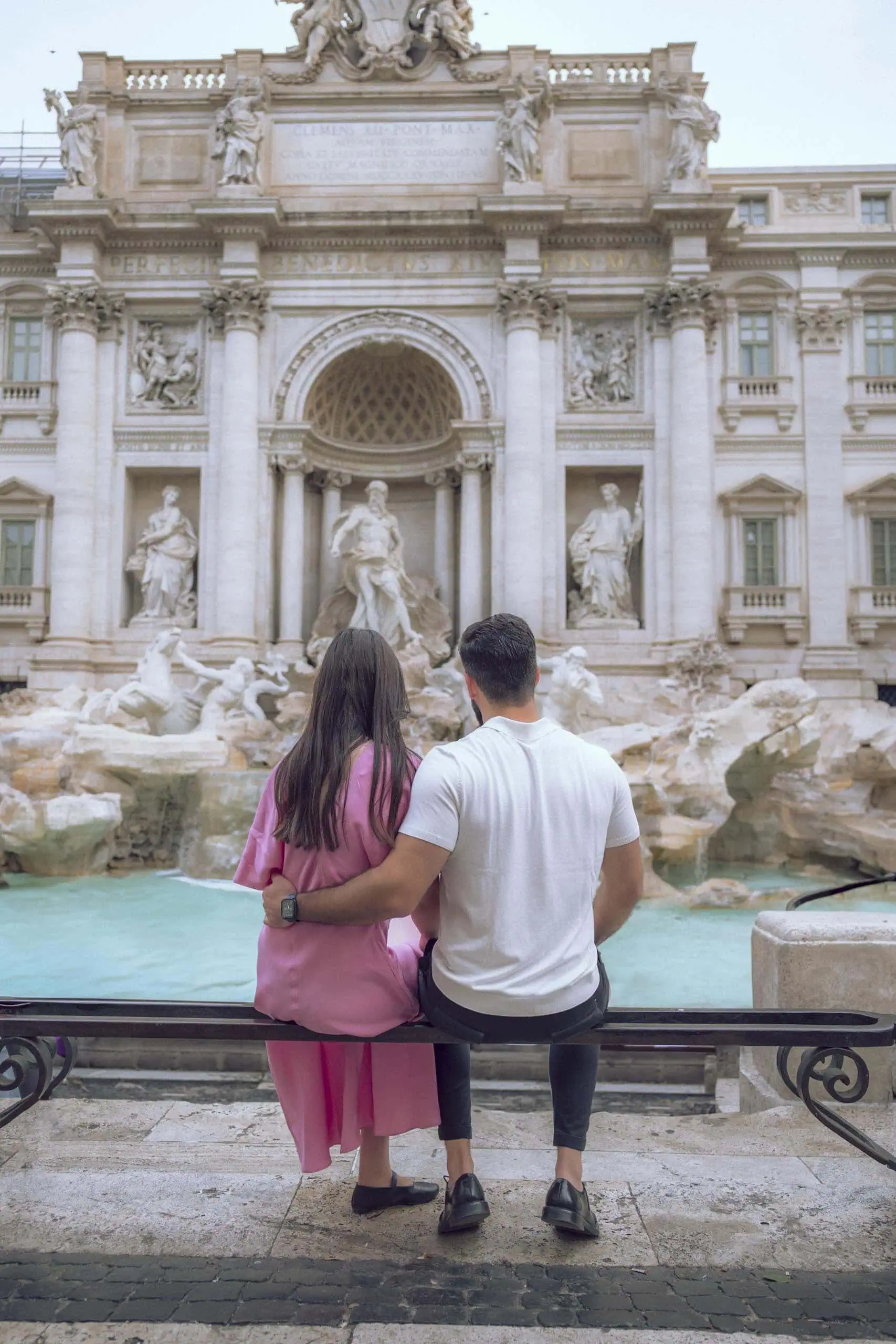
For standing shots, let your arms hang with a small gap between elbow and torso. That gap stops arms from being flattened against the body, which widens the silhouette and kills any sense of movement. For seated shots at a low wall or fountain step, resting hands lightly on the knees or crossed loosely in the lap keeps them visible and relaxed without the shot feeling posed.
TipIf you are unsure where to put a hand, rest it lightly on your own forearm or waist rather than letting it dangle flat.
Good posture in a portrait is not rigid military straightness. It is shoulders back and slightly down, spine long, chin level or very slightly forward and down. That last point matters: pulling the chin back is the single most common posture mistake, because it shortens the neck and creates shadow under the jaw. Moving the chin forward and down by a centimetre or two lengthens the neck and sharpens the jawline in the final image.
Shifting weight onto one leg rather than standing square to the camera immediately softens the whole body and adds a natural tilt to the hips and shoulders. It also gives you somewhere to be rather than just standing. This applies to both solo and group shots. For couples, leaning slightly toward each other from the hip creates visual connection without any forced contact.
TipImagine a thread pulling the crown of your head gently upward. It fixes posture faster than any verbal instruction.
The fastest way to make hands look natural is to give them something to do. In a Rome session this is easy: adjusting a jacket collar, holding a bag strap, touching a scarf, or resting a hand against a stone wall all occupy the hand with a real action and eliminate the frozen look. The moment there is a task, the hand relaxes and the photo reads as candid even when fully posed.
Movement between frames works the same way. I ask people to walk toward me, turn a corner, or simply look away and then back. The hand position on any moving frame is always more natural than a held pose because the muscles are not sustaining an artificial position. At locations like Trastevere or the Roman Forum, the environment itself gives you things to interact with, which is one reason I use them regularly. "Give the hands something to do and the whole body follows," Finzi says. "I rarely need more than one walking pass at any location before the tension is gone."
TipIf you carry a bag, hold it in one hand at your side rather than over both shoulders for street-style shots.
For couples, the connection between hands is more important than any individual hand position. Loosely linked fingers, one hand resting on the other's arm, or a hand placed on a shoulder all read as genuine contact. The key word is loosely. Gripped, tightly interlocked hands look effortful in a photo even when they feel natural in person. I ask couples to hold hands as they would walking through a market, not as they would for a formal ceremony photograph.
For families with children, hands work best as a framing device: a parent's hand on a child's shoulder, or a child holding an adult's hand from below, creates a natural compositional triangle that links everyone without anyone needing to hold a pose. I direct this quickly on location. You do not need to rehearse group arrangements in advance.
TipFor a natural couple shot, I ask partners to walk together and then stop. The hold that forms in that pause is always the right one.
Rome gives hands somewhere to go without any props required. The column bases at the Roman Forum, the low walls at Gianicolo, the steps at the Spanish Steps and at the Colosseum, and the iron railings at Pincio all offer natural resting points that look organic in a photo. Leaning an elbow on a wall or resting one hand flat against ancient stone reads in the image as someone present in the place rather than posing in front of it.
Stairs are particularly useful for posture. Sitting sideways on a step, with one arm resting across the knees and the other hand relaxed, solves the hand problem and the posture problem simultaneously. I use seated stone-step positions at multiple locations specifically because they remove most of the self-consciousness that standing poses produce. The session typically covers three to five kilometres across Rome's streets, so you will also have natural movement between locations that produces some of the best frames.
TipTouch the wall or surface with just the fingertips rather than a full flat palm. It looks lighter and more considered in the frame.
Not every frame needs hands in it. A tight portrait from the shoulders up, or a shot framed at mid-chest, removes the hand question entirely. I frame several images per session this way, particularly at locations where the background is the visual anchor, such as the Colosseum or the Trevi Fountain at night. If hands do not add to the story of that specific frame, I crop them out.
The same applies to movement shots where one or both hands blur slightly into gesture. A half-visible hand in motion is always more interesting than a stiffly held one in full view. Part of my editing process is selecting the frames where the hands are working and discarding the ones where they are not. You do not need to nail hand position on every shot. That is what the session and the edit are for.
TipIf you feel self-conscious mid-pose, tell me. I will change the frame or move to a different shot before continuing.
I work across 30 locations in Rome and guide posture and hand placement throughout every session. You do not arrive with a pose list. You arrive, I direct, and within 24 hours you have edited images you can use. The Essential session is one hour at one location, the Signature is two hours across two locations, and the Prestige covers three hours and three locations. A €30 deposit locks your date.
Rescheduling is free and available anytime. I recommend booking two to four weeks ahead, especially April through October, though last-minute slots do sometimes open. Contact me directly to check.
TipIf you want to practise a few poses before arriving, spend two minutes in front of a mirror shifting weight onto one leg and relaxing your hands. That alone puts you ahead of 90 percent of first-time subjects.
Quick answers to the questions visitors ask before they book.
“Finzi made us feel completely at ease from the first minute. The photos look nothing like typical tourist shots and our hands and posture look natural in every single one.”
Pick a session. Choose a date. I handle the rest.
BOOK NOW