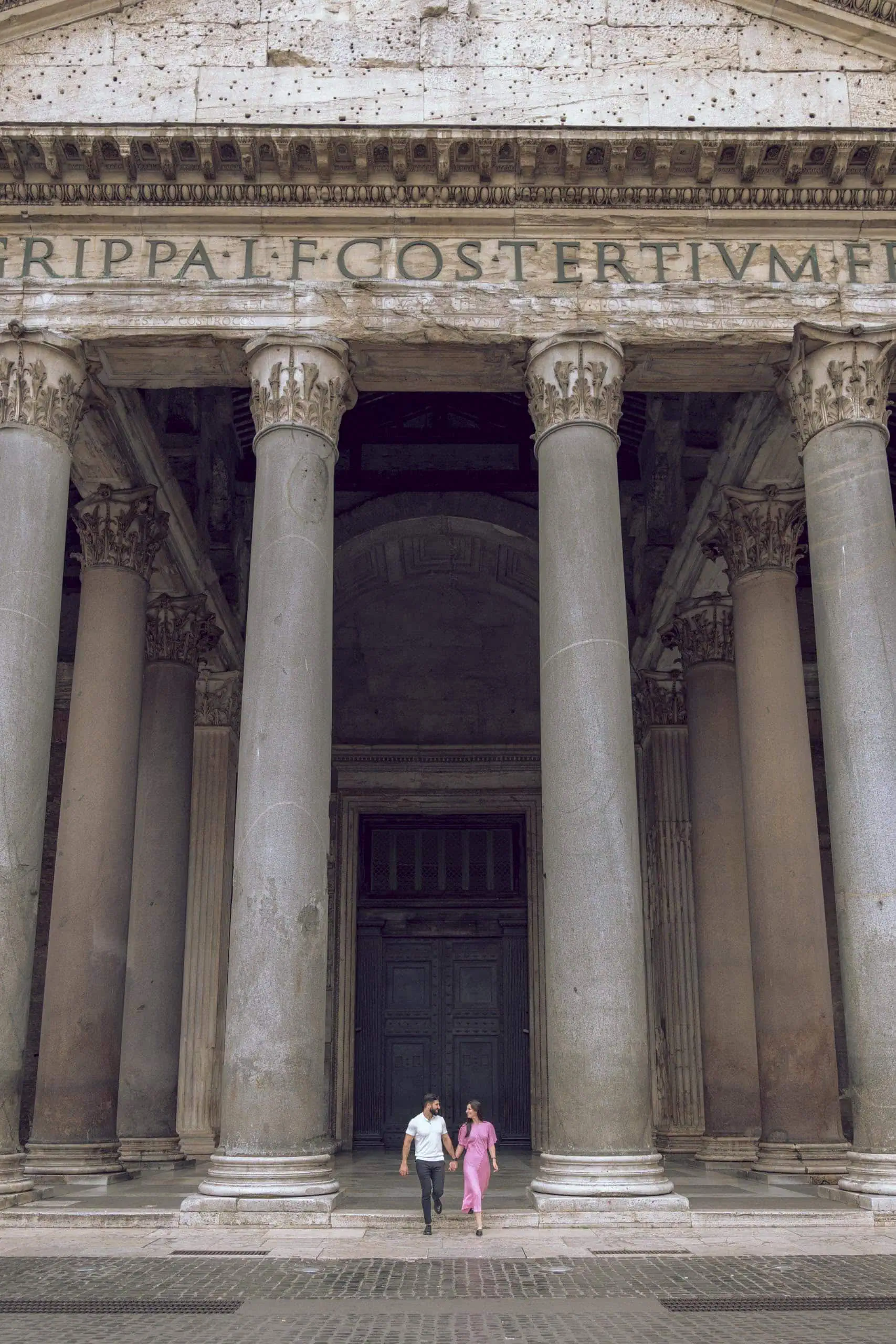
Summer and winter outfit checklist, church dress rules and shoes for Rome sessions
For a Rome photoshoot, wear loose, breathable cotton or linen in light solid colours in summer, and a long coat over smooth knitwear with a scarf and waterproof closed shoes in winter. Both seasons need comfortable shoes for walking and a wrap or sleeves that cover your shoulders if you plan to enter a church.
This guide is for couples, families and solo travellers deciding what to pack for a session with me. Rome's weather swings a lot between seasons. July afternoons typically reach about 31°C, while January highs sit around 11 to 12°C, so the same outfit will not work in both. Below you will find a season-by-season checklist, the Vatican dress rule, shoe advice, colour and fabric choices, and how weather affects booking.
Pick outfits for the person you are photographing, not for the weather forecast alone. In summer the aim is to stay cool and avoid sweat marks and creasing. In winter the aim is to stay warm without bulky layers that hide your shape and make you stiff.
Both seasons share the same base rules. Choose one outfit per person that you feel relaxed in, avoid clothes you keep adjusting, and keep shoulders and knees coverable for church entry. Everything else in this guide builds on those three points.
TipLay the outfits out together the night before. Colours that clash on the bed will clash in the photos.
| Package | Price | Duration | Photos | Locations |
|---|---|---|---|---|
| Essential | €300 | 1 hour | 30 photos | 1 location |
| Signature | €500 | 2 hours | 50 photos | 2 locations |
| Prestige | €800 | 3 hours | 60 photos | 3 locations |
For a summer Rome photoshoot, wear loose cotton or linen in light, solid colours and carry a thin scarf for sun and for covering shoulders. Breathable fabrics like cotton or linen are the standard advice for Roman summers, and they photograph well because they move softly in the air. Skip heavy synthetics, which hold heat and show sweat quickly.
Heat is the main planning factor. Average highs are around 31 to 32°C, but heatwaves regularly push afternoon temperatures into the high 30s, and the summer of 2026 had several of them. The Health Ministry publishes a daily heat-wave level for Rome, so check it before your session day. A meteorologist who travelled Italy during a heat wave recommended lightweight fabrics, preferably in light colours, for scarves and wraps.
I schedule summer sessions around the light and the temperature. Sunrise and the hour before sunset (golden hour) give the softest, most flattering light, and they are also the coolest parts of the day. "In July I move people to sunrise or golden hour, and the outfit that works is the one you can stand in without thinking about it," Finzi says.
TipDark, tight fabrics show heat marks first. Light and loose is easier in 30°C-plus weather.
For a winter Rome photoshoot, wear a long coat over smooth knitwear, add a scarf and gloves, and choose waterproof closed shoes. One packing guide gives the same tips for January: pack layers, a warm coat, and waterproof shoes. Expect 12 to 13°C by day and 3 to 5°C at night from December through February.
Rome's winters are wet more than they are cold. Winter is the wettest time of year, with about 93 mm of rain in December, and snow is rare but can occasionally fall in January and February. Bring a compact umbrella and a coat that still looks good when it is slightly damp. Light rain actually creates dramatic skies and intimate moods, and I work in most weather conditions.
Daylight is shorter, so winter sessions are planned tighter. January has roughly 9 to 10 hours of daylight against about 15 in July. Wear layers you can open or remove between locations, because you will be walking and then standing still. "In winter I tell people to dress for the standing, not the walking, because you cool down fast between shots," Finzi says.
TipThin, smooth layers under a good coat look sharper in photos than one thick knit.
Yes, shoulders must be covered, and knees too, to enter St. Peter's Basilica. The official St. Peter's Basilica dress code page states "Shoulders must be covered for all visitors." The basilica's Dome page adds that clothing must show shoulders and knees covered. Church rules do not change with the season, so a summer tank top and short shorts will not work if you plan to go inside.
The rule applies to entering the basilica, but it is easiest to plan for from the start. In summer, a thin scarf or shawl over a sleeveless top solves it, or choose a dress or trousers that reach the knee. In winter, leggings under a skirt or dress keep you warm and meet the rule.
Vatican City is one of the 30+ locations I shoot across Rome, and it is a common pairing with the Colosseum and Trevi Fountain. If your session includes it, tell me whether you plan to go inside afterwards so we can plan the order of the day.
TipKeep the wrap in your bag. It also works as a sun cover or an extra layer.
Closed, cushioned flats, clean trainers or low block heels work best, because a session usually involves 3 to 5 km of walking. Rome's historic streets are stone-paved and uneven, so thin heels and slippery soles are a poor choice in either season. Choose shoes you have already broken in.
In summer, breathable leather or canvas is comfortable, and open sandals only suit people who walk in them daily. In winter, waterproof boots or shoes with grip matter more than style, since wet stone is slippery. Bring a spare pair of socks if rain is forecast.
Shoes appear in full-length and walking shots, so keep them clean and avoid loud logos. "Everyone remembers the dress and forgets the shoes, then the shoes are in half the frames," Finzi says.
TipCarry a small bag for swapping shoes only if you are sure you will use it. Extra bulk slows the walk.
Solid, muted colours photograph best against Rome's warm stone, so choose cream, sage, navy, terracotta, soft blue or deep green. In summer, lighter tones also reflect the sun. In winter, deeper tones such as burgundy, camel and charcoal look rich against grey skies. My style is clean, modern and centred on real connection, so clothes should support the people in the frame, not compete with them.
Avoid tiny stripes, small checks, large logos and neon, which can look busy or flicker on camera. If you are photographing as a couple or family, coordinate rather than match: pick a shared palette of two or three colours and let each person wear a different shade. Fabrics with some structure hold their shape better than thin jersey.
Check how each outfit looks sitting down and when the wind lifts it. Long skirts and scarves move well in photos, but they need to be light enough to move without tangling.
I recommend booking at least 2 to 4 weeks in advance, especially during peak season (April to October). Click any Book Now button on the site to choose your session type, select a package, and pick your date. A €30 deposit secures your date. Rescheduling is free anytime, so a forecast of rain or a heat wave does not lock you in. Heavy storms trigger a free postponement.
Pick a session to match the season. Essential is €300 for 1 hour, 30 photos and 1 location. Signature is €500 for 2 hours, 50 photos and 2 locations, and it is the most popular. Prestige is €800 for 3 hours, 60 photos and 3 locations. The Night Session is €450 and covers the Colosseum and Trevi Fountain beautifully lit at night, so bring an extra layer in winter. I deliver within 24 hours.
In summer I lean towards the cooler ends of the day, and in winter I plan around the shorter daylight. Either way, tell me where you are staying and what you plan to wear, and I will suggest locations that suit your outfits.
TipIf you are undecided between two outfits, bring both and show me before we start.
Quick answers to the questions visitors ask before they book.
Pick a session. Choose a date. I handle the rest.
BOOK NOW