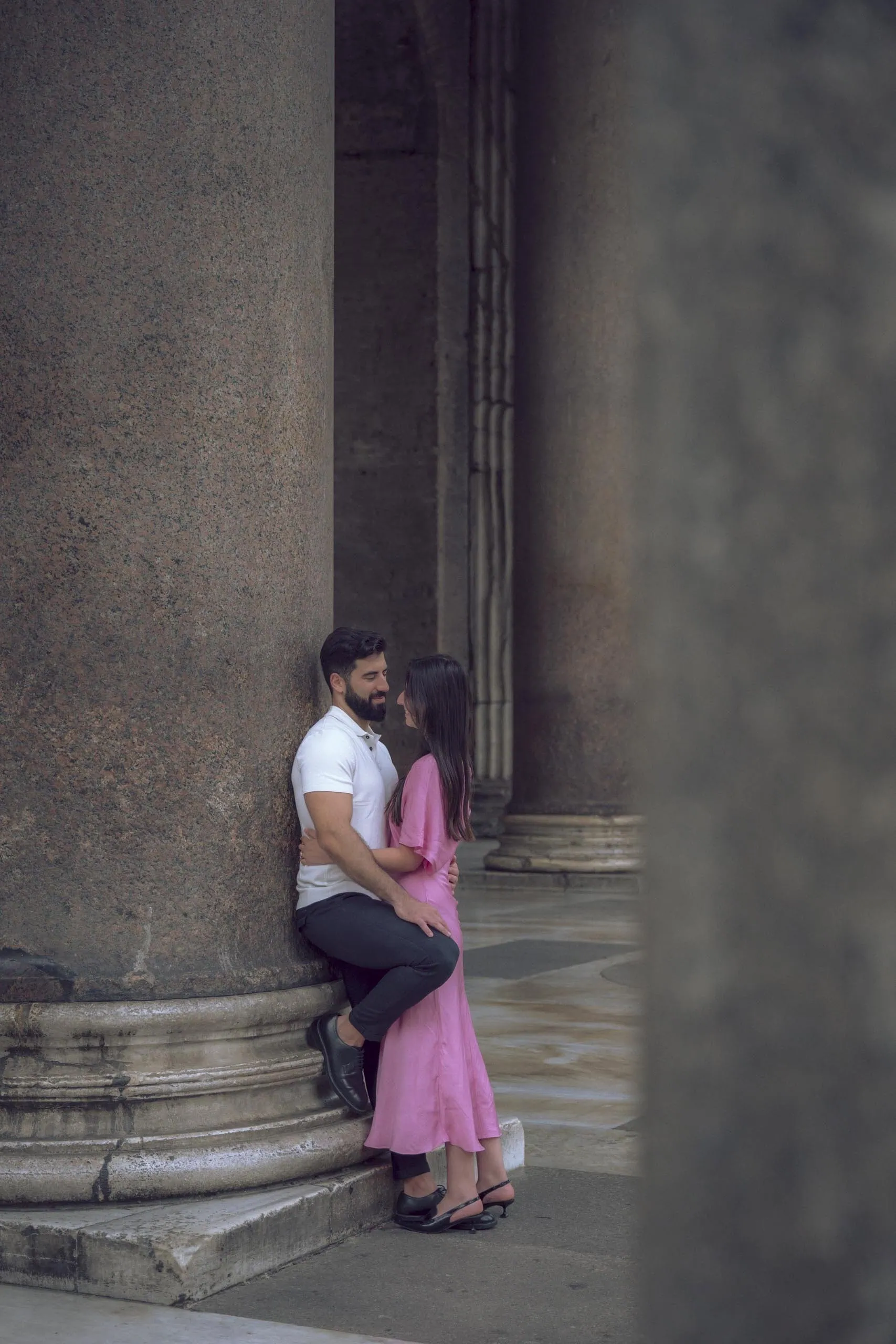
Light, crowds, and logistics compared so you can decide
For most couples, sunset is the better default choice for a Rome photoshoot: the light arrives when you are already awake and dressed, the city's warm stone glows from the west, and locations like Trastevere and the Spanish Steps face exactly the right direction. Sunrise wins on one specific variable, crowds, and that single advantage makes it the right call at a handful of locations where midday and afternoon foot traffic would otherwise make portraits impossible.
This guide compares both sessions head to head: the light quality each produces, which Roman locations favour which direction, how crowd patterns differ by time of day, and what to consider when your trip gives you only one slot. It is for couples planning any session from one hour to three, at any time of year.
Both windows produce the same quality of light in one important sense. According to Wikipedia's article on golden hour photography), the golden hour is the period "shortly after sunrise or before sunset, during which daylight is redder and softer than when the sun is higher in the sky." The physics is identical morning and evening: the sun sits low, its rays travel through more atmosphere, blue wavelengths scatter away, and what lands on skin and stone is warm and directional without being harsh. According to the NOAA Global Monitoring Laboratory, "at sunrise and sunset the sun's rays travel through a long path of atmosphere," making the warm, scattered light at both ends of the day physically identical in character.
The practical difference is direction. In summer, Rome's sun rises to the northeast and sets to the northwest, meaning east-facing monuments catch warm front light at dawn while west-facing locations catch it at dusk. The Colosseum's main facade faces east and southeast, so it glows most dramatically at sunrise. Trastevere's lane-lined streets and the Spanish Steps, which face west and southwest, collect the most flattering light in the final hour before dark. Knowing which way your chosen location faces tells you more than any general rule about which session to book.
TipCheck which direction your chosen location faces before deciding. A west-facing piazza in soft morning light is backlit, not golden.
| Package | Price | Duration | Photos | Locations |
|---|---|---|---|---|
| Essential | €300 | 1 hour | 30 photos | 1 location |
| Signature | €500 | 2 hours | 50 photos | 2 locations |
| Prestige | €800 | 3 hours | 60 photos | 3 locations |
At the most-visited sites, yes. Walks of Italy notes that "early morning (around sunrise) is by far the best moment for a quieter visit, when the crowds are thin and the light is soft." At the Trevi Fountain, by mid-morning tour groups arrive in waves and the surrounding streets become packed; arriving before the crowds build is the only reliable way to get clean frames at the fountain without strangers filling the background. The same pattern applies at the Colosseum, the Roman Forum, and Piazza Navona, all of which thin dramatically in the earliest morning hours.
Sunset does not deliver the same crowd advantage at those specific locations. In the evening, the historic centre has already been busy since mid-morning, and visitors who have spent the day touring are still moving through the major sites. That said, Trastevere's residential lanes, the Pincio terrace, and Villa Borghese are far less overwhelming at sunset than at the Colosseum or Trevi Fountain at any hour, and they deliver better light in the evening direction anyway. The crowd argument for sunrise is strongest at the most-visited monuments; it matters less at neighbourhoods and gardens.
TipIf your session includes the Trevi Fountain or Roman Forum, sunrise is the practical choice regardless of light direction preference.
Sunrise works best at the Colosseum, Roman Forum, and Trevi Fountain. The Colosseum faces east, so the first light hits its arched facade directly, producing warm depth across the stone. The Roman Forum's columns cast long shadows westward at dawn, creating natural framing and texture. At the Trevi Fountain, low population and softer morning light combine to produce frames that are simply impossible to achieve at any other hour.
Sunset works best at Trastevere, the Spanish Steps, the Gianicolo, the Pincio, and Castel Sant'Angelo. The Spanish Steps face west-southwest and catch the final golden light looking down via Condotti toward the setting sun. Trastevere's narrow medieval lanes, with their terracotta plasterwork, trap and amplify the warm evening tones. The Gianicolo terrace faces west across the city, making it one of the finest vantage points in Rome for an evening session with the entire skyline behind the couple.
TipPiazza Navona is enclosed enough that light quality is similar at both ends of the day; there the sunrise crowd advantage is the deciding factor.
This is where most couples make their decision, and it is a fair one to make on logistics alone. Sunset sessions require no alarm at 5 AM. You arrive at a location after a day of sightseeing, already in your chosen outfit, and the session ends with the city still lively around you. That is an easier experience to choreograph than a pre-dawn departure from a hotel room. Sunset is also forgiving: if the session runs a few minutes long, the blue hour that follows can produce equally strong images with a different mood.
Sunrise demands commitment. The light window is shorter at some times of year, arrives earlier than most hotel restaurants open breakfast, and requires arriving at a location before the city's transport is fully running. That said, the reward is real. "When I shoot the Colosseum at sunrise," Finzi says, "there are moments where the light hits the stone and there are almost no other people in frame. That combination does not exist at any other hour." If you are willing to set the alarm, the payoff at the right location is a session that feels completely private in one of the most-visited cities in Europe.
TipFor a multi-location session, consider starting at a sunrise-friendly monument at dawn, then resting before a second location at golden hour in the evening.
Yes, significantly. Rome's solar data shifts the practical timing of both windows across the year. In June and July, evening golden hour runs from roughly 8 PM to 9 PM, giving you long days and late beautiful light but requiring you to stay out well into the evening. In December and January, it arrives by mid-afternoon, meaning a sunset session can finish before dinner. Sunrise in summer comes very early, when streets are genuinely empty; in winter it arrives at a far more civilised hour and still delivers crowd-free conditions at the major monuments.
October and April are widely considered the optimal months for Rome photography: the light is angled lower than in summer, the air is clearer, and visitor numbers are smaller across the city. In those shoulder months, both sunrise and sunset sessions are practical and produce excellent results. High summer favours the couple prepared to wake early, because sunset sessions at 8 PM push against many people's dinner plans. Deep winter favours sunset: it arrives earlier, the city is less crowded throughout the day, and the cooler tones in the sky add contrast behind warm stone.
TipIn summer, the sunrise session has the biggest crowd advantage because the city stays busy until late at night and is only quiet in the earliest hours.
The Essential session (€300, 1 hour, 1 location) suits a single focused slot at either sunrise or sunset. If you have chosen one famous location, one lighting window, and want a clean set of thirty edited images, this is the right fit. The Signature session (€500, 2 hours, 2 locations) opens up the option of pairing a crowd-free dawn location with a different neighbourhood in softer mid-morning light, or combining two sunset-facing spots across an evening.
The Prestige session (€800, 3 hours, 3 locations) makes it possible to begin at sunrise at the Colosseum and move on to two further locations as the morning develops, or to build a full evening arc from a high viewpoint at golden hour to a street-level neighbourhood in blue hour. A Night Session (€450) is a separate option for couples who want the Colosseum or Trevi Fountain lit after dark rather than either golden hour window. All sessions require a €30 deposit to lock the date, and reschedules are free with no time limit.
TipDelivery for all sessions is within 24 hours. You will have your images before most people have finished their post-trip laundry.
Quick answers to the questions visitors ask before they book.
“Finzi made the whole session feel effortless. The light was perfect and the photos arrived the next morning. We could not believe how beautiful they were.”
Pick a session. Choose a date. I handle the rest.
BOOK NOW