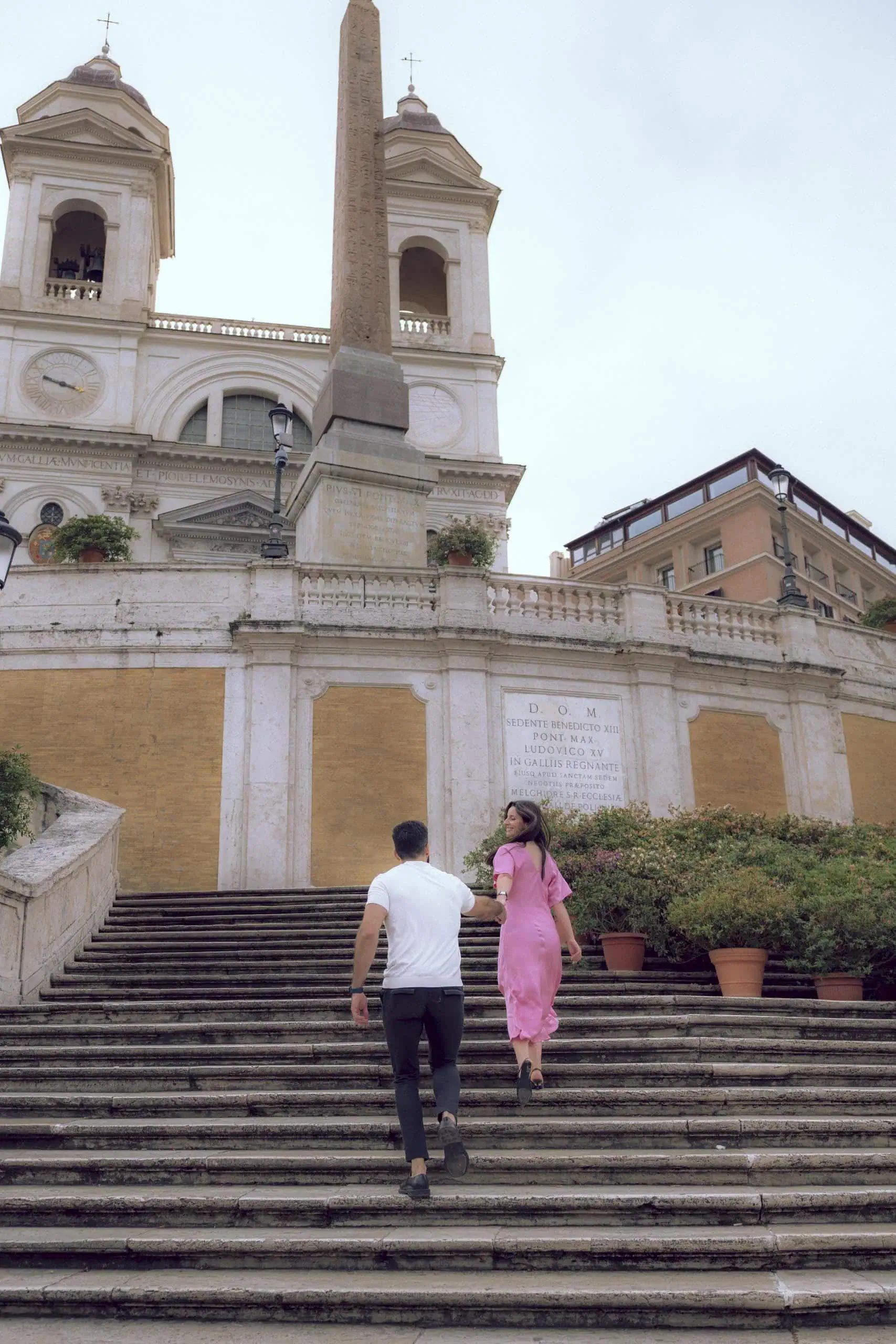
How to match your session package to Rome's geography
One location is the right choice when your priority is depth at a single famous site. Two locations make sense when you want contrast, more variety in your gallery, and you have the time to move between neighbourhoods. This guide breaks down which sessions cover how many locations, how Rome's geography affects the choice, and how to build a route that does not waste half your session walking.
I shoot at over 30 locations across Rome. The question I get from most clients is not which spots look good but how many spots are realistic in the time they have. The answer depends almost entirely on where those spots sit on the map, and on which package you book.
The Essential session is one hour, one location, 30 photos. That is the right fit if you want to go deep at a single landmark rather than sprint between two. The Signature session is two hours, two locations, 50 photos, and it is the most popular choice for couples and families who want variety without exhaustion. The Prestige session runs three hours, three locations, 60 photos, and works best when clients have a clear wishlist of contrasting settings.
Those time windows include actual shooting time at each location, not just transit. Factor in that Rome's cobblestone streets slow your pace, and that the best shots at any landmark often come after a few minutes of settling in. A two-location session at spots that are 30 or more minutes apart on foot can feel rushed; one that links two nearby sites gives you full breathing room at both.
TipIf you are unsure between Essential and Signature, ask yourself: do you want one location done beautifully, or two locations done well? Both are valid goals.
| Package | Price | Duration | Photos | Locations |
|---|---|---|---|---|
| Essential | €300 | 1 hour | 30 photos | 1 location |
| Signature | €500 | 2 hours | 50 photos | 2 locations |
| Prestige | €800 | 3 hours | 60 photos | 3 locations |
Rome's most photogenic sites sit in two broad clusters. The historic centre, roughly the area containing the Pantheon, Trevi Fountain, Piazza Navona, and the Spanish Steps, is compact. According to visitrome.com, a day in this area can include the Pantheon, Piazza Navona, and Trevi Fountain, all reachable within a 20-minute walk. That density makes combining two or three of those sites in a single session genuinely workable.
The second cluster is older Rome: the Colosseum, Roman Forum, and Palatine Hill sit together at the eastern edge of the centre. Trastevere, on the west bank of the Tiber, is a separate character entirely, with narrow medieval lanes and a completely different visual texture from the baroque fountains of the centre. The Vatican sits northwest. These more separated areas are better treated as the anchor for their own session zone rather than a quick add-on to a historic centre shoot.
TipThe closer your two chosen locations sit to each other, the more actual shooting time you get at each one.
Distance matters more than it looks on a tourist map. The Trevi Fountain to the Pantheon is roughly a five-minute walk. The Pantheon to Piazza Navona is another five minutes. The Spanish Steps to the Trevi Fountain is about 15 minutes. These are all walkable links that fit comfortably into a two-location Signature session without losing time to transit. The Colosseum, by contrast, is about 20 minutes on foot from the Pantheon, and Trastevere sits across the river, roughly 15 minutes from the historic centre on a direct route.
Trastevere to the Vatican is about a 20-minute walk north. The Vatican to the Spanish Steps requires crossing back across the city, which is where a taxi or the Metro Line A to Ottaviano or Spagna stations becomes the more practical choice. If your two chosen locations fall in different city zones, plan a short transfer into the session rather than assuming it is all walkable. I account for this when we discuss the route, and it shapes the order of locations as much as the light does.
TipCobblestones slow pace noticeably; wear comfortable shoes, especially if the session covers more than one location.
One location works best when the site itself has visual range: multiple angles, different distances, changing backgrounds as you move around it. The Colosseum is a strong single-location choice because the exterior, the arches viewed from Via Sacra, and the surrounding grounds each produce a different frame. The Trevi Fountain, which the Comune di Roma administers as one of the city's protected Baroque monuments, has crowds that shift constantly, meaning the same spot looks different at different moments within a single session.
Single-location sessions also suit proposals. I shoot proposals with a hidden camera, which means I need to be in position before anything happens. Moving between two locations with a hidden setup is not practical, so the Proposal session is structured around one carefully chosen site. If a dramatic location change after the moment is what you want, that is a conversation for a different session type.
TipFor the Colosseum and Trevi Fountain at night, the Night Session is its own dedicated format, separate from the standard packages.
The best two-location pairings offer visual contrast: one grand and open, one intimate and narrow. A Trevi Fountain session followed by the cobblestone alleys near Piazza Navona gives you scale contrast. Trastevere paired with the Gianicolo viewpoint gives you street texture then panoramic Rome. The Colosseum area paired with a walk along the Roman Forum's perimeter gives you two completely different angles on the same ancient zone without a long transfer. Contrast in setting translates directly into contrast in the gallery, which is what makes the edited set feel like a full story rather than a repeated background.
"The pairing I suggest most often for a two-location session is one open landmark and one narrow neighbourhood street," Finzi says. "The wide shot and the close, intimate shot complement each other in the final edit in a way that a single location, even a large one, cannot fully replicate."
TipPairs within the same neighbourhood zone keep transit time under ten minutes and protect your shooting time at both spots.
Yes. The light and the crowd levels at each location shift throughout the day, and that affects the order as much as the geography. The Trevi Fountain is at its quietest at sunrise and late at night. If you start there at sunrise, moving to the Pantheon or Piazza Navona as a second location is a natural continuation: the light stays soft, the streets are still relatively clear, and both sites are a short walk away. Booking the same pairing at midday adds 30 or more minutes of waiting for gaps in the crowd at the fountain, which cuts into actual shooting time.
Trastevere photographs well at any hour but comes into its own in the late afternoon and early evening, when the low light hits the ochre walls and the lanes empty of the lunch crowd. Pairing Trastevere with a late golden-hour viewpoint on the Gianicolo is one of the most consistently productive two-location routes I run. The Gianicolo sits directly above Trastevere: from the neighbourhood streets to the belvedere is a short uphill walk.
TipBook earlier in the day for the Trevi Fountain if it is one of your two locations. I handle the crowd logistics, but starting early gives both of us more to work with.
You do not need to arrive in Rome with a finalised route. When you book, choose your session type and preferred date. Click any Book Now button on the site, select your package, and pick your date. A €30 deposit locks the date. Once the booking is confirmed, I discuss the location options with you directly, based on what you want the photos to feel like, where you are staying, and what time of day works best for the light at your chosen spots. I deliver all edited images within 24 hours of the session.
Rescheduling is free, with no time limit attached. If you want to move a session because your plans change, contact me directly and we sort it out. Peak season runs from April to October, when locations like the Trevi Fountain and Spanish Steps see the heaviest visitor numbers, so booking 2 to 4 weeks in advance gives the most flexibility in route planning and timing.
TipLast-minute bookings are sometimes possible. Contact me directly to check availability.
Quick answers to the questions visitors ask before they book.
“Finzi was incredibly professional and talented. He knew exactly where to go and when for the best light. Our photos were delivered the next day and were absolutely striking.”
Pick a session. Choose a date. I handle the rest.
BOOK NOW