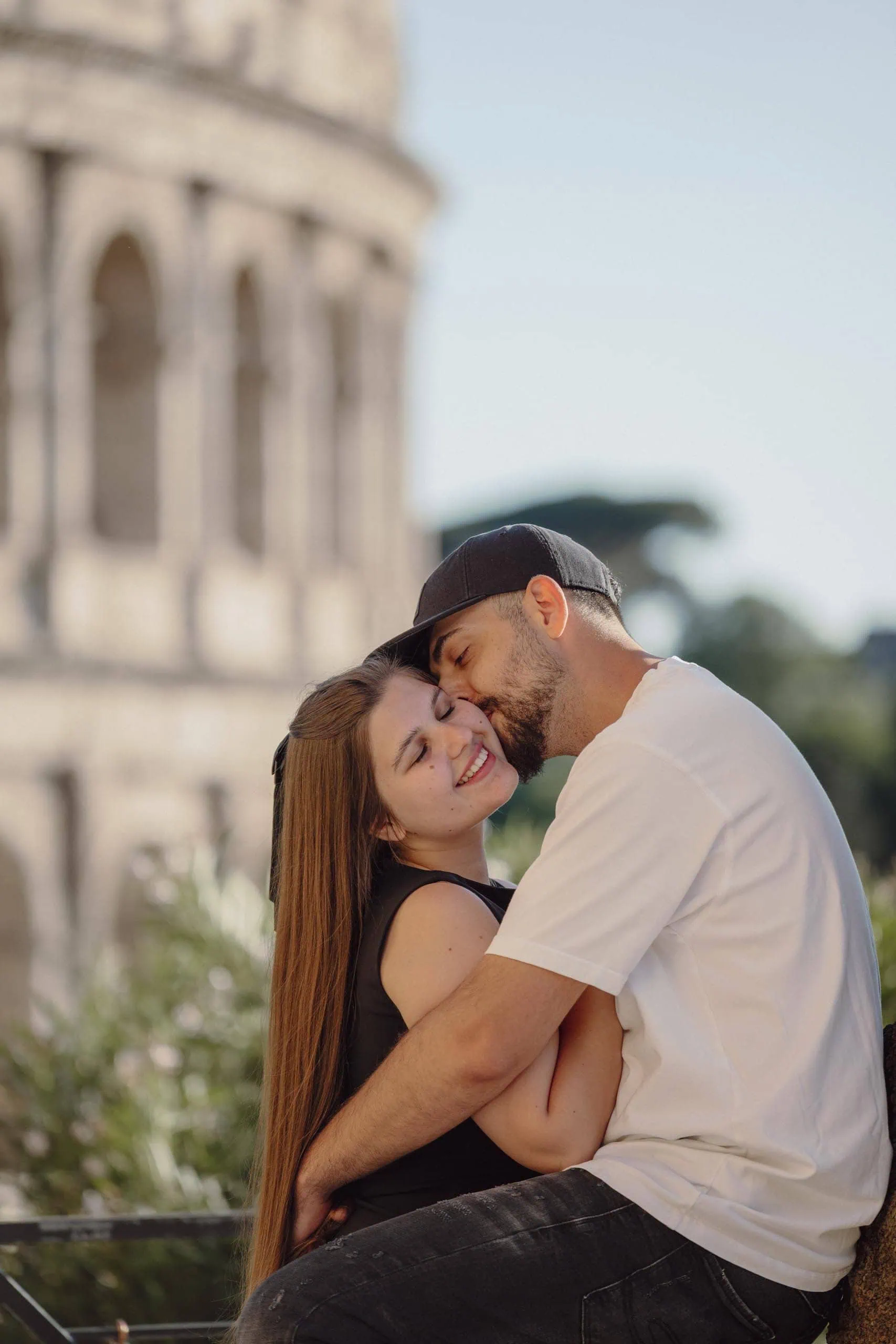
A practical method for picking your best images after your Rome shoot
Picking your favourite photos from a Rome session is easier when you have a clear method: start by separating the photos you feel something from, then narrow by variety, and only then worry about the technical details. Most people do it backwards, zoom into every pore, dismiss half the gallery, and end up with a shortlist that all looks the same. This guide gives you a repeatable process that works whether you received 30 images from an Essential session or 60 from a Prestige.
The process applies to every session type: couples, families, solo portraits, proposals. It takes about 20 minutes if you follow the steps in order. The goal is a final set that covers different moods, distances, and Rome backdrops, not a set of near-identical frames where everyone is smiling at the camera from the same angle.
Open the gallery. Scroll through every image once, quickly, without pausing. Mark only the ones that make you stop, the ones where something registers before you have time to think. This is your emotional shortlist. It will be bigger than your final selection, and that is fine. Resist the urge to zoom in at this stage. Zooming in on the first pass causes people to discard images for tiny reasons before they have evaluated the set as a whole.
Couples often find they each have a slightly different shortlist. Review the gallery independently first, then compare. The overlap is usually where the strongest images sit. Photos that appear on both lists should move straight to your confirmed set. Photos on only one list deserve a second look together before you decide.
TipIf you are reviewing on a phone, switch to a larger screen before the first pass. Small screens compress detail and flatten light in ways that make good images look flat.
| Package | Price | Duration | Photos | Locations |
|---|---|---|---|---|
| Essential | €300 | 1 hour | 30 photos | 1 location |
| Signature | €500 | 2 hours | 50 photos | 2 locations |
| Prestige | €800 | 3 hours | 60 photos | 3 locations |
A set of 30 images where 20 are close-up smiles at the Trevi Fountain is not a strong gallery, even if each individual frame is technically excellent. Variety across distance, mood, and location is what makes a collection feel complete. When reviewing your shortlist, mentally sort images into three buckets: wide establishing shots that show Rome clearly behind you, mid-range frames where faces and body language read together, and close detail or candid shots where the connection between people is the whole story.
Aim to have at least one image from each bucket per location. If your shortlist has six images from the same spot at the same distance, compare them side by side and keep the one with the most distinctive expression or light. The others, however nice, are duplicates. Fewer stronger photos carry more impact than a gallery of near-identical frames.
TipFinzi shoots across multiple angles and focal lengths at each location precisely so your gallery has natural variety built in. Trust the edit to give you range, then use these buckets to confirm it.
Only after your emotional shortlist is stable should you check technical quality. The things that actually matter at this stage: is the focus on the eyes sharp, is anyone mid-blink in a way that changes the photo's feeling, and are there background distractions that pull the eye away from the subject? A tourist walking through frame is rarely a problem in Rome, it is part of the city. A road sign bisecting a head is worth flagging.
Blinking is the most common reason to drop an otherwise strong image. Check the eyes at 100 percent if you are unsure. If two nearly identical frames exist and one has a cleaner blink, keep the cleaner one. If only one frame exists and the blink is partial rather than fully closed, the emotion in the image usually wins anyway. Full mid-blink eyes with zero other redeeming quality are the only clear cut.
TipSkin texture viewed at 100 percent on a monitor looks nothing like a printed photo or an Instagram post. Do not discard an image because of normal skin detail visible only at extreme zoom.
Every image in your delivered gallery has already passed Finzi's own selection. "I cut every frame where the light, the focus, or the connection between people is not there," Finzi says. "What you receive is a set I would be comfortable showing anywhere." The gallery you receive is not a raw contact sheet. It is the result of a full editorial pass, which means when you open it, you are already working with a pre-filtered set. Your job is to find your personal favourites within a gallery that has already been held to a professional standard.
Delivery happens within 24 hours of your session. That speed matters for the selection process: Rome is still fresh, you remember how each moment felt, and that emotional memory makes the first pass more accurate. Waiting weeks to review photos puts you in a colder frame of mind where technical details start to feel more important than they actually are.
TipReview your gallery on the day it arrives. Your gut reaction on day one is more reliable than a considered re-review a week later.
If you had a Signature or Prestige session covering two or three locations, organise your selection process by location, not by scrolling the full gallery as one block. Reviewing Trastevere images against Trastevere images, then Piazza Navona against Piazza Navona, gives each setting a fair chance. Rome locations have completely different light, colour palettes, and backgrounds. Mixing them in one unsorted pass means the warm-toned golden hour frames often outcompete the cooler midday frames even when the cooler frames are compositionally stronger.
Once you have a shortlist per location, then view the full set together. This is where you check that the overall gallery tells a complete story of the session, different places, different moods, different framings. A session that moves from the Spanish Steps to Trastevere should feel like a journey, not a repetition.
TipNight session images from the Colosseum or Trevi Fountain have very different contrast and colour to daytime frames. Keep them in a separate bucket during the first pass.
Yes. An image that works well as a phone wallpaper or Instagram post is not always the same image that works as a large print. For large prints, wide shots with strong architectural context carry better than tight close-ups, which can pixelate or feel claustrophobic at scale. For sharing on screen, close portraits and candid moments with clear facial expressions almost always outperform scenic wide shots where the people are small in the frame.
Think about where the photo will live before finalising your shortlist. If you want one image for a wall print of Rome, look for a frame where the city's architecture is clearly visible and the composition has breathing room. If you want a set of images for a shared album, favour variety and candid feeling over any single technically perfect frame. The Leica Camera AG galleries describe their standard for display photography as work of "the highest standard" in both artistic and technical quality, a useful benchmark when you are deciding which images are strong enough to enlarge and hang.
TipHorizontal (landscape) frames work better as wide prints. Vertical (portrait) frames fill a phone screen or a standing canvas better. Check your orientation before committing to print size.
The most common problem is reviewing photos of yourself the same way you look in a mirror. Mirrors show a reversed image. Cameras show the real thing. Most people have a slightly preferred side they are used to seeing and will automatically favour photos from that angle, even when photos from the other side are objectively stronger. Try reviewing images where you cover your own face first and look only at the scene, the light, and the composition. Then look at the faces. This changes the order in which information reaches you and reduces mirror-bias.
The second common mistake is keeping near-identical images out of guilt. If two frames are almost the same, keeping both does not give you more memories, it dilutes the impact of each. Pick the one where the expression, light, or connection between people is marginally stronger and let the other go. A tighter gallery of images you love completely is worth more than a larger gallery where half the set feels like backup copies.
TipAsk someone who was not at the session to look at your shortlist. Their reaction to each image is free of the memories attached to the day and will often confirm or challenge your instincts usefully.
The Essential session delivers 30 photos from one location in one hour. The Signature delivers 50 photos from two locations in two hours. The Prestige delivers 60 photos from three locations in three hours. More images from more locations gives you a wider raw set to work with and makes the variety buckets described above easier to fill. If you already know you want a diverse gallery with strong architectural shots and strong candid portraits, a Signature or Prestige session gives you more material to select from.
Every session is confirmed with a €30 deposit. Rescheduling is free and available any time. Finzi delivers within 24 hours, so your selection process begins the day after your session, while the memories are sharp.
TipMore photos is not always better for selection purposes. 50 images with strong variety is easier to work with than 60 images where many are near-identical. Variety in the shoot produces variety in the gallery.
Quick answers to the questions visitors ask before they book.
“Finzi made the whole experience completely natural. The photos arrived the next morning and I could not believe how many I wanted to keep. Every single one told a different story.”
Pick a session. Choose a date. I handle the rest.
BOOK NOW